
Verified Rides, Shared Booking and Daily Commute in Gorakhpur — Gorakhnath Temple transfers, local travel and intercity trips to Lucknow on Routism.
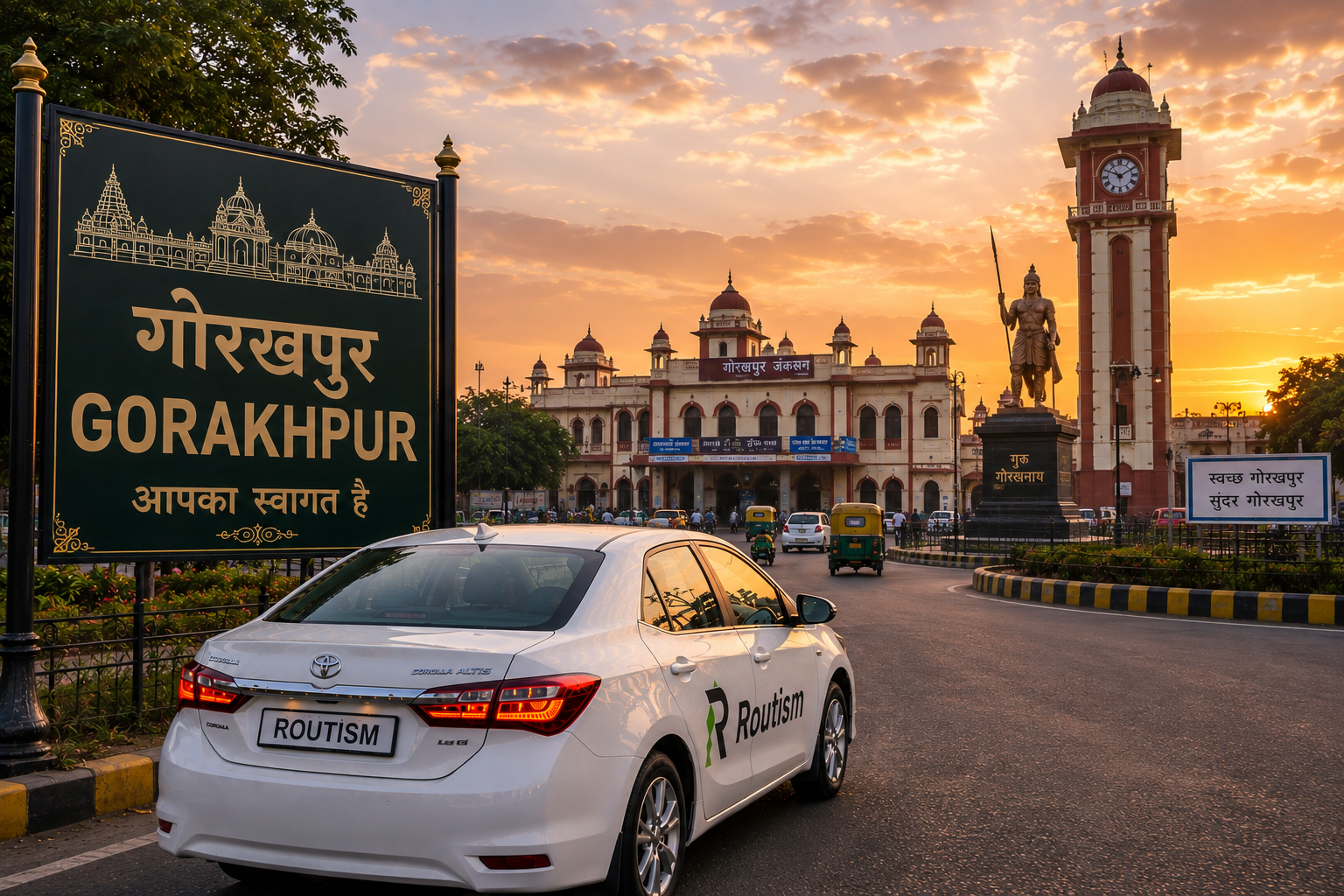
Gorakhpur, a historic city on the banks of the Rapti river in the Purvanchal region of eastern Uttar Pradesh, is home to roughly 1.3 million people within municipal limits and around 2.5 million across its wider metro area, with the district as a whole projected to cross 5.3 million by 2026. Named after the revered ascetic Gorakshanath and home to the historic Gorakhnath Math — one of the most important monasteries of the Nath sect and a temple that draws large crowds year-round, especially during its month-long Makar Sankranti Mela — Gorakhpur is also a major administrative and educational centre, serving as the headquarters of Gorakhpur district, the North Eastern Railway Zone, and Gorakhpur division, and home to institutions including AIIMS Gorakhpur and Gorakhpur University.
Routism is a mobility platform that connects customers with verified drivers to make everyday and long-distance travel safe, secure, affordable and convenient, and Gorakhpur — with its blend of daily pilgrim traffic, a large student and administrative population, and its role as a key railway junction near the Nepal border — is exactly the kind of city our network is built to serve. As part of our roadmap to cover all of Uttar Pradesh from our headquarters in Lucknow, join the waiting list to get early access the moment Routism opens matching in Gorakhpur.
Gorakhpur's daily mobility pattern is shaped by several overlapping demands rarely found together at this scale in one city. As one of the busiest railway junctions in North Eastern Railway's network, Gorakhpur Junction handles enormous daily passenger footfall, much of which needs a final local leg to reach hotels, the Gorakhnath Temple, AIIMS Gorakhpur, or one of the city's colleges. At the same time, the city's population density within municipal limits runs close to 5,800 people per square kilometre — a genuinely dense urban core — and continues to grow steadily each year, adding pressure to local roads that, as in most fast-growing Uttar Pradesh cities, haven't expanded at the same pace.
Layered on top of this is Gorakhpur's role as a significant pilgrim and religious destination in its own right, with the Gorakhnath Temple drawing large numbers of daily visitors and especially heavy crowds during the annual Makar Sankranti Mela. Most of this travel today — whether it's a pilgrim arriving by train, a student commuting to campus, or a resident's daily office run — happens through solo bookings arranged on the spot, exactly the pattern that gets slower, less predictable and more expensive during the city's busiest periods.
Routism runs on three core booking systems, each suited to how people actually move through Gorakhpur — whether they're pilgrims visiting the Gorakhnath Temple, students commuting to campus, or residents making the same local trip every week.
Book a ride to match your exact need, with competitive fares and rating-based transparency behind every driver.
Shared Booking matches customers travelling on similar Gorakhpur routes at similar times. Enter your pickup and drop-off, and Routism identifies compatible co-riders heading the same way — for a railway station transfer, a temple visit, or a long intercity drive to Lucknow or Varanasi. When a match is available, co-riders join the same booking and split the cost between them.
Shared Booking helps to split travel costs, make journeys more affordable, reduce unnecessary empty seats, improve overall vehicle utilisation, potentially reduce the number of vehicles needed on the same route, ease traffic congestion during peak Mela periods and busy train arrival windows, and turn a solo transfer into a more connected, social way of travelling. It supports local, one-way, outstation and round-trip journeys, depending on route compatibility — same direction, same journey, less cost, better utilisation.
Not everyone in Gorakhpur is a visitor. Daily Commute is built for residents, students, hospital staff, railway employees and professionals who travel the same route at the same time, day after day — a pattern especially relevant in a city with a large university population, a major medical institution in AIIMS Gorakhpur, and a significant railway workforce tied to the North Eastern Railway headquarters. Instead of creating a fresh booking every day, set up a recurring booking for multiple days at once. Routism connects you with suitable drivers and co-commuters on a compatible route and schedule, with route matching, time matching, daily reminders and a predictable, reliable arrangement for everyday travel — a real local commute partner instead of a different arrangement every single week. The recurring booking continues until you or your driver cancels it.
For customers: stop searching for the same ride every day — set your route once and commute with ease. For drivers based in Gorakhpur: build regular customers between pilgrim seasons and spend less time searching for new bookings every day.
Gorakhpur's most significant landmark, the Gorakhnath Math, sits about 4–4.5 km from Gorakhpur Junction railway station and roughly 12 km from Gorakhpur Airport, and is considered the most important monastery of the Nath sect, drawing pilgrims year-round and especially large crowds during its month-long Makar Sankranti Mela. Nearby, the Vishnu Temple, the city's Railway Museum — a nod to Gorakhpur's deep railway heritage — the historic Imambara, and the popular Ramgarh Taal lake round out the city's core visitor circuit, alongside family-friendly green spaces like Neer Nikunj Park and Govt. Vindhyavasini Park. Each of these is easily reachable with a Local Ride instead of negotiating a fresh auto fare at every stop.
Gorakhpur's transport network reflects its role as a major eastern Uttar Pradesh hub. Gorakhpur Airport (GOP), located about 7 km from Gorakhpur Railway Station on the Gorakhpur–Kushinagar Highway (NH-28), has seen passenger numbers climb sharply in recent years — surpassing 867,000 annual passengers — with regular flights connecting the city to Delhi, Lucknow and other major hubs. Gorakhpur Junction, the headquarters of the North Eastern Railway zone, is one of the busiest and longest railway platforms in the world, handling a huge volume of daily passenger traffic on routes connecting Delhi, Mumbai, Kolkata and destinations across eastern India. The city sits roughly 273 km east of Lucknow, connected by both road and a well-served rail corridor.
For travellers arriving at any of these points — pilgrims heading to the Gorakhnath Temple, students arriving for the semester, or business travellers in for a short trip — a verified Routism Ride or a cost-split Shared Booking is a more predictable way to complete the journey than negotiating with an unfamiliar local driver on arrival.
Gorakhpur's position in eastern Uttar Pradesh, close to the Nepal border, makes it a natural gateway for several major intercity and pilgrim corridors. Gorakhpur to Lucknow, roughly 273 km, connects the Purvanchal region's largest city to the state capital, carrying steady administrative, business and family traffic. Gorakhpur to Ayodhya and Gorakhpur to Varanasi link Gorakhpur to two of Uttar Pradesh's most significant pilgrimage destinations, drawing travellers who combine multiple sacred sites into a single trip. Gorakhpur to Kushinagar, a shorter but historically significant route connecting Gorakhpur to one of Buddhism's most important pilgrimage sites, sees steady religious and tourist travel.
Instead of paying full fare for a solo cab across any of these routes, a traveller can book an Outstation Ride directly, or join a Shared Booking with another traveller already heading the same way — turning one long drive into a shared, more affordable trip for everyone on it. Round-Trip Rides cover the same route out and back in a single booking, ideal for a same-day Lucknow-to-Gorakhpur temple visit or business trip. Read more about the broader Uttar Pradesh intercity network on the Uttar Pradesh state page, and see how the corridor works from the other end on the Lucknow city page.
Gorakhpur's travel demand carries two distinct rhythms. The Makar Sankranti Mela at Gorakhnath Temple, held every January, is the city's single biggest pilgrim event, drawing large sustained crowds over several weeks and putting real pressure on local roads around the temple and the railway station. Alongside this, Gorakhpur's academic calendar — driven by Gorakhpur University, AIIMS Gorakhpur and the city's other institutions — creates its own predictable surges around admission season and semester starts, when large numbers of students and families arrive within a short window needing station and airport transfers, hostel moves and city orientation trips.
Outside these peaks, Gorakhpur's daily travel settles into a steady rhythm built around its railway workforce, hospital and university staff, and local business community — exactly the kind of predictable, everyday demand Daily Commute is designed to serve, alongside the more seasonal spikes that Local and One-Way Rides and Shared Booking can absorb.
Gorakhpur's identity is rooted in two very different forces that shaped it over centuries. The city takes its name from Gorakshanath, the ascetic founder of the Nath tradition, whose monastery at Gorakhnath Math remains the spiritual heart of the city and one of the most important Nath establishments anywhere in India, alongside sister monasteries like Asthal Bohar. Centuries later, the arrival of the railways transformed Gorakhpur into an entirely different kind of hub — today it serves as the headquarters of the North Eastern Railway zone, and Gorakhpur Junction is recognised as one of the longest railway platforms in the world, a distinction that reflects just how central the city became to rail travel across eastern Uttar Pradesh and the wider region bordering Nepal.
That dual identity — spiritual centre and railway city — is part of why Gorakhpur's daily travel patterns look the way they do: a steady baseline of pilgrim, student and railway-worker movement punctuated by sharp seasonal peaks. It's also why local infrastructure keeps expanding to match; Gorakhpur Airport's passenger numbers have grown by nearly 20% year-on-year in recent reporting, a clear sign that both business and leisure travel to the city are climbing faster than road capacity has kept pace.
Verified drivers. Every driver on Routism goes through a verification process before their profile can accept a booking, which matters even more for pilgrims and students unfamiliar with local routes, fair fares and trustworthy drivers.
Affordable travel. Competitive fares across Rides, plus cost-splitting through Shared Booking, help pilgrims, students and residents alike reduce what they spend on transfers, especially across longer intercity routes like Gorakhpur to Lucknow or Varanasi.
Flexible booking. Choose between Local, One-Way, Outstation or Round-Trip Rides, a Shared Booking, or a recurring Daily Commute — whatever the trip actually needs, whether you're visiting for a single darshan or studying and working in the city.
Ratings and trust. Customer and driver ratings build transparency and accountability into every match, giving visitors and new students a real signal of who they're travelling with.
Better vehicle utilisation. Shared bookings make fuller use of the vehicles already moving through Gorakhpur's busiest corridors, instead of adding more half-empty cars to an already-congested railway station and temple approach during peak periods.
Recurring connections. Daily Commute lets Gorakhpur's students, hospital staff and railway employees build long-term travel relationships instead of repeatedly searching for a new local booking every single day.
Trust matters most in a city that welcomes a constant flow of first-time visitors — pilgrims, new students, patients travelling to AIIMS Gorakhpur — who don't know local routes, fair fares or trustworthy drivers. Every driver on Routism completes verification before their profile can accept a booking. Fares are transparent and agreed before the trip starts — never haggled over on the roadside, which is especially valuable during the Makar Sankranti Mela and admission season when demand-driven price spikes are common. And ratings from both customers and drivers keep the whole Gorakhpur travel community accountable over time. Full detail on this process is on the how it works page, and specific questions are answered on the FAQ.
Most travellers in Gorakhpur today choose between a few options: negotiate an auto or e-rickshaw fare on the spot, book a private taxi through a local operator, or rely on city buses for local travel. Each has a real drawback. Negotiating on the spot means paying whatever the moment's demand allows, particularly around Gorakhpur Junction during peak train arrival times. A private taxi booking usually means paying full fare alone, even when other travellers on your train or flight are headed to the exact same temple or campus. And city buses, while affordable, run on fixed routes that don't always match specific hostel, hospital or residential addresses.
Routism sits in between: close to the door-to-door convenience of a private vehicle, at a fraction of the cost when a Shared Booking match is available, with driver verification and a rating system that neither a roadside negotiation nor a fixed-route bus can reliably offer.
The process is short, whether you're a pilgrim in town for a single visit or a resident commuting locally:
For now, the first step is the waiting list — it's how early access, founding member status and route priority get decided as Gorakhpur's matching network comes online.
No places have been published for this city yet.
Common questions about Smart, Safe & Affordable Mobility in Gorakhpur — Routism.
Is Routism available in Gorakhpur yet? Gorakhpur is part of Routism's Uttar Pradesh expansion roadmap, following our launch in Lucknow. Join the waiting list for early access as matching opens in the city.
Can Routism help with airport or railway station transfers in Gorakhpur? Yes — One-Way and Local Rides are built exactly for transfers from Gorakhpur Airport or Gorakhpur Junction to your hotel, the Gorakhnath Temple, or your campus.
Can I book a shared ride from Lucknow to Gorakhpur? Yes — Outstation Rides and Shared Booking both cover the Gorakhpur–Lucknow corridor, along with routes to Ayodhya, Varanasi and Kushinagar. See the Lucknow city page and the Uttar Pradesh state page for more on these corridors.
Is Routism useful outside the Makar Sankranti Mela season? Yes — Daily Commute is built for Gorakhpur's students, hospital staff and railway employees who need reliable local travel year-round, not just during the city's major pilgrimage event.
How does Routism keep rides safe for pilgrims and new students unfamiliar with Gorakhpur? Every driver completes a verification process before a booking is offered, fares are transparent and agreed upfront rather than negotiated on arrival, and a customer-and-driver rating system keeps the community accountable. Details are on the how it works and FAQ pages.
Can I book a round trip for a same-day Gorakhnath Temple visit? Yes — Round-Trip Rides cover the onward and return journey together in a single booking, ideal for a same-day visit from Lucknow or nearby cities.
Routism — safe journeys, smart connections, better mobility. Starting from Lucknow. Available across Uttar Pradesh.
Join the waiting list with your name, mobile number, email and route to get early access the moment Routism opens in Gorakhpur. Explore the broader network on the Uttar Pradesh state page, see how the Gorakhpur–Lucknow corridor works from our headquarters city on the Lucknow page, or read how Routism works.
End of Gorakhpur city page content.