Verified Rides, Shared Booking and Daily Commute in Hardoi — local travel and intercity trips to Lucknow, just 110 km away, all on Routism.
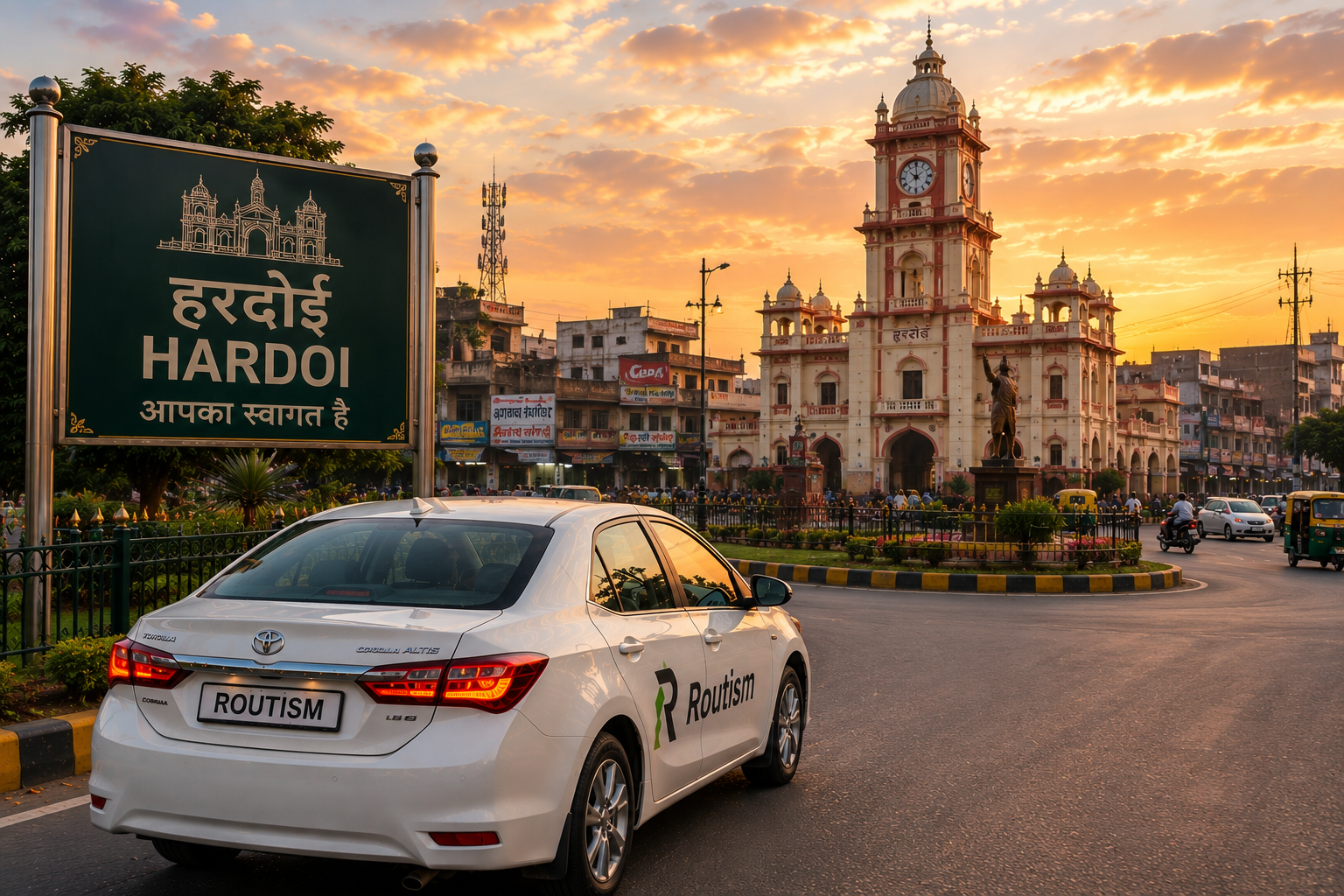
Hardoi, the headquarters town of one of Uttar Pradesh's largest districts by area, sits on the fertile Ganga-Yamuna Doab roughly 110 km northwest of Lucknow — close enough to fall within Lucknow Division and the historical Awadh region, yet far enough to run its own distinct rhythm of daily life. The city itself is home to just under 200,000 people, but the wider Hardoi district, the 13th-most populous in Uttar Pradesh, holds over 4 million residents across nearly 6,000 square kilometres, with roughly 80% of that population living in rural areas built around agriculture, grain trade and small-scale industry.
Routism is a mobility platform that connects customers with verified drivers to make everyday and long-distance travel safe, secure, affordable and convenient, and Hardoi — with its role as a district administrative centre, a market town for grain and sugarcane, and a steady flow of daily travellers to and from Uttar Pradesh's capital — is exactly the kind of city our network is built to serve. As part of our roadmap to cover all of Uttar Pradesh from our headquarters in Lucknow, join the waiting list to get early access the moment Routism opens matching in Hardoi.
Hardoi's daily mobility pattern is shaped by its role as both a self-contained district headquarters and a satellite town closely tied to Lucknow. As the administrative seat for a district of over 4 million people spread across five tehsils — Hardoi, Shahabad, Sandila, Bilgram and Sawayajpur — the city draws a constant stream of visitors from surrounding towns and villages for government offices, courts, markets and healthcare, on top of its own resident population's daily travel. At the same time, Hardoi's proximity to Lucknow, just under two hours away by road or rail, means a significant number of residents travel that corridor regularly for work, business, higher education and family reasons — a pattern common to many towns that sit within a state capital's wider economic orbit.
Hardoi's local economy adds its own layer of demand. The city functions as a market centre for grain and other crops grown across the surrounding plains, and its industries include sugar milling, potassium nitrate processing and woodworking — each generating its own daily flow of workers, traders and buyers moving between residential areas, markets and mills. Most of this travel today happens through solo auto-rickshaw and shared-tempo bookings, arranged informally with no fixed fare and no verification, exactly the gap a dedicated mobility platform is built to close.
Routism runs on three core booking systems, each suited to how people actually move through Hardoi and the wider district.
Book a ride to match your exact need, with competitive fares and rating-based transparency behind every driver.
Shared Booking matches customers travelling on similar Hardoi routes at similar times. Enter your pickup and drop-off, and Routism identifies compatible co-riders heading the same way — for a daily market or mill commute, a station transfer, or a long intercity drive to Lucknow or Kanpur. When a match is available, co-riders join the same booking and split the cost between them.
Shared Booking helps to split travel costs, make journeys more affordable, reduce unnecessary empty seats, improve overall vehicle utilisation, potentially reduce the number of vehicles needed on the same route, ease traffic congestion around Hardoi's markets and district offices, and turn a routine commute into a more connected, social way of travelling. It supports local, one-way, outstation and round-trip journeys, depending on route compatibility — same direction, same journey, less cost, better utilisation.
Daily Commute is built for people who travel the same Hardoi route at the same time, day after day — sugar mill and grain-market workers, government and administrative staff, students, teachers, and any other regular commuter making the same journey repeatedly, including the many who travel the Hardoi–Lucknow corridor for work or study on a weekly basis. Instead of creating a fresh booking every day, set up a recurring booking for multiple days at once. Routism connects you with suitable drivers and co-commuters on a compatible route and schedule, with route matching, time matching, daily reminders and a predictable, reliable arrangement for everyday commuting — a real commute partner instead of a different arrangement every single week. The recurring booking continues until you or your driver cancels it.
For customers: stop searching for the same ride every day — set your route once and commute with ease. For drivers: build regular customers and spend less time searching for new bookings every day.
Hardoi's daily travel spans the district headquarters town itself and its network of surrounding tehsil towns. Within Hardoi city, the areas around the district collectorate, the grain market and the railway station generate the heaviest daily footfall. Beyond the city, Sandila, one of Hardoi district's five tehsils and a town in its own right, sits closer to the Lucknow side of the district and sees regular cross-town travel. Shahabad and Bilgram, the district's other main tehsil towns, each generate their own local commute patterns tied to markets, schools and administrative offices, with a steady flow of travel back to Hardoi town for anything requiring the district headquarters.
Popular routes we expect to prioritise at launch: local trips to the grain market and district collectorate, transfers to and from Hardoi Junction railway station, cross-town travel between Sandila and Hardoi, and Outstation Rides on Hardoi ↔ Lucknow. Join the waiting list and tell us your own route — it directly shapes which Hardoi corridor we switch on first.
Hardoi sits on a major rail line running from Jammu & Kashmir through to West Bengal via Moradabad, Bareilly and Lucknow, with Hardoi Junction functioning as the district's main railway hub, handling an estimated 29,000 passengers a day and recently rebuilt with expanded platform capacity. On the road, Hardoi sits at a major junction on Uttar Pradesh's central highway network, connecting the city directly to Lucknow, Kanpur, Shahjahanpur and Sitapur. Hardoi has no airport of its own — the nearest is Chaudhary Charan Singh International Airport in Lucknow, roughly 110 km away, reached by road, rail or UPSRTC bus.
For travellers arriving at Hardoi Junction, especially those unfamiliar with fair local auto and tempo rates, a verified Routism Ride or a cost-split Shared Booking is a more predictable way to complete the journey to your home, business or the district collectorate than negotiating a fresh fare at the station gate.
Hardoi's position roughly 110 km northwest of Lucknow, within the state capital's wider Lucknow Division, makes Outstation Rides and Shared Booking especially useful here. Hardoi to Lucknow, connected by both road and a direct rail corridor with dozens of daily long-distance trains passing through, carries a steady flow of business, administrative, educational and family travel between the district headquarters and the state capital. Hardoi to Kanpur, linking the city to Uttar Pradesh's largest industrial centre, sees consistent business and trade travel. Hardoi to Shahjahanpur and Hardoi to Sitapur, both neighbouring districts, carry regular short-haul travel for markets, family visits and administrative business.
Instead of paying full fare for a solo cab across any of these routes, a traveller can book an Outstation Ride directly, or join a Shared Booking with another traveller already heading the same way — turning one drive into a shared, cheaper trip for everyone on it. Round-Trip Rides cover the same corridor out and back in a single booking, useful for a same-day Hardoi-to-Lucknow business trip. Read more about the broader Uttar Pradesh intercity network on the Uttar Pradesh state page, and see how the corridor works from the other end on the Lucknow city page.
Hardoi's local economy runs on grain, sugarcane and the small-scale industry built around them — a market town where trading, milling and processing generate a large, predictable daily workforce commute. Sugar mills and grain-market traders alike depend on workers, buyers and staff travelling fixed routes at fixed hours, day after day during the harvest and milling seasons especially. This is precisely the pattern Daily Commute is designed around. A shared commute for a group of mill workers, or a set of traders making the same daily run between a village and the Hardoi grain market, can meaningfully cut what each person spends on daily transport — a genuine benefit in a district where 80% of the population lives rurally and depends on affordable, reliable travel into town for work, trade and essential services.
Hardoi district's boundaries have deep roots — its present form was created by the British after their takeover of Awadh in 1856, though the region itself was divided between the Lucknow and Khairabad sarkars as far back as Akbar's reign in the 1500s. The name Hardoi is itself a distorted form of "Haridrohi," reflecting the area's long-standing local identity, and the district's fertile position on the Ganga-Yamuna Doab plains — bordered by the Ganges to the south and drained by numerous tributaries, with the Gomti river marking its eastern edge with Sitapur — has shaped its economy around agriculture for centuries. That geography also gave rise to the jhils, or swampy lakes, and stretches of forest that still dot the southwestern part of the district today.
That long agricultural and administrative history is part of why Hardoi's daily travel needs look the way they do: a district headquarters town serving a vast, largely rural population spread across five tehsils and hundreds of villages, all needing predictable, affordable transport into town for markets, government offices, schools and healthcare — exactly the kind of everyday mobility gap that a verified, flexible platform like Routism is built to close, both within Hardoi itself and along its steady, well-travelled corridor into Lucknow.
Verified drivers. Every driver on Routism goes through a verification process before their profile can accept a booking, so Hardoi customers connect with people who have actually been checked.
Affordable travel. Competitive fares across Rides, plus cost-splitting through Shared Booking, help Hardoi's commuters, traders and students reduce what they spend without giving up convenience.
Flexible booking. Choose between Local, One-Way, Outstation or Round-Trip Rides, a Shared Booking, or a recurring Daily Commute — whatever the trip actually needs, whether it's a mill shift or a Lucknow business trip.
Ratings and trust. Customer and driver ratings build transparency and accountability into every match, so decisions about who to travel with in Hardoi are based on real signals, not guesswork.
Better vehicle utilisation. Shared bookings make fuller use of the seats already on Hardoi's roads, instead of adding more half-empty vehicles to an already busy market and station area.
Recurring connections. Daily Commute lets Hardoi's mill workers, traders, students and government staff build long-term travel relationships instead of repeatedly searching for a new booking every single day.
Trust is the entire premise of shared travel, so it's built into every layer of Routism rather than left to chance. Every driver completes verification before their profile can accept a booking. Fares are transparent and agreed before the trip starts — never haggled over on the roadside once you're already committed. And ratings from both customers and drivers keep the whole Hardoi community accountable over time. Full detail on this process is on the how it works page, and specific questions are answered on the FAQ.
Most Hardoi residents currently choose between several options for any given trip: drive alone, book a full-fare solo auto or taxi, or rely on informal shared tempos for local and short-distance travel. Each has a real drawback. Driving alone means covering fuel and maintenance by yourself for a trip that could easily be shared. A solo auto or taxi means paying full fare for a route others in your village or neighbourhood are likely travelling too. And informal shared tempos, while cheap and widely used across rural Uttar Pradesh, offer no verification, no fixed fare, and no reliability from one day to the next — particularly relevant in a district where most residents live outside the city itself and depend on that final road connection into Hardoi town.
Routism sits in between: close to the door-to-door convenience of a private vehicle, at a fraction of the cost of travelling alone, with verification and a rating system that neither an informal shared tempo nor a random roadside arrangement can reliably offer.
The process is short, whether you're commuting daily to the grain market or planning a one-off Outstation Ride to Lucknow:
For now, the first step is the waiting list — it's how early access, founding member status and route priority get decided as Hardoi's matching network comes online.
No places have been published for this city yet.
Common questions about Smart, Safe & Affordable Mobility in Hardoi — Routism.
Is Routism available in Hardoi yet? Hardoi is part of Routism's Uttar Pradesh expansion roadmap, following our launch in Lucknow. Join the waiting list for early access as matching opens in the city.
Can Routism help with railway station transfers in Hardoi? Yes — One-Way and Local Rides are built exactly for transfers from Hardoi Junction to your home, business or the district collectorate.
Can I book a shared ride from Hardoi to Lucknow? Yes — Outstation Rides and Shared Booking both cover the Hardoi–Lucknow corridor, along with routes to Kanpur, Shahjahanpur and Sitapur. See the Lucknow city page and the Uttar Pradesh state page for more on these corridors.
Is there a Routism option for sugar mill or market shift workers in Hardoi? Yes — Daily Commute matches you with riders and drivers whose route and working hours genuinely overlap, which fits Hardoi's mill and market shift patterns as well as standard office commutes.
How does Routism keep rides in Hardoi safe? Every driver completes a verification process before a booking is offered, fares are transparent and agreed upfront, and a customer-and-driver rating system keeps the community accountable. Details are on the how it works and FAQ pages.
Does Routism cover travel between Hardoi and its surrounding tehsil towns? Yes — Local and Outstation Rides both cover travel between Hardoi town and nearby tehsils like Sandila, Shahabad and Bilgram, and Daily Commute is available for anyone making that trip regularly.
Routism — safe journeys, smart connections, better mobility. Starting from Lucknow. Available across Uttar Pradesh.
Join the waiting list with your name, mobile number, email and route to get early access the moment Routism opens in Hardoi. Explore the broader network on the Uttar Pradesh state page, see how the Hardoi–Lucknow corridor works from our headquarters city on the Lucknow page, or read how Routism works.
End of Hardoi city page content.