
Verified Rides, Shared Booking and Daily Commute in Jhansi — the Gateway to Bundelkhand. Local travel and intercity trips to Lucknow, all on Routism.
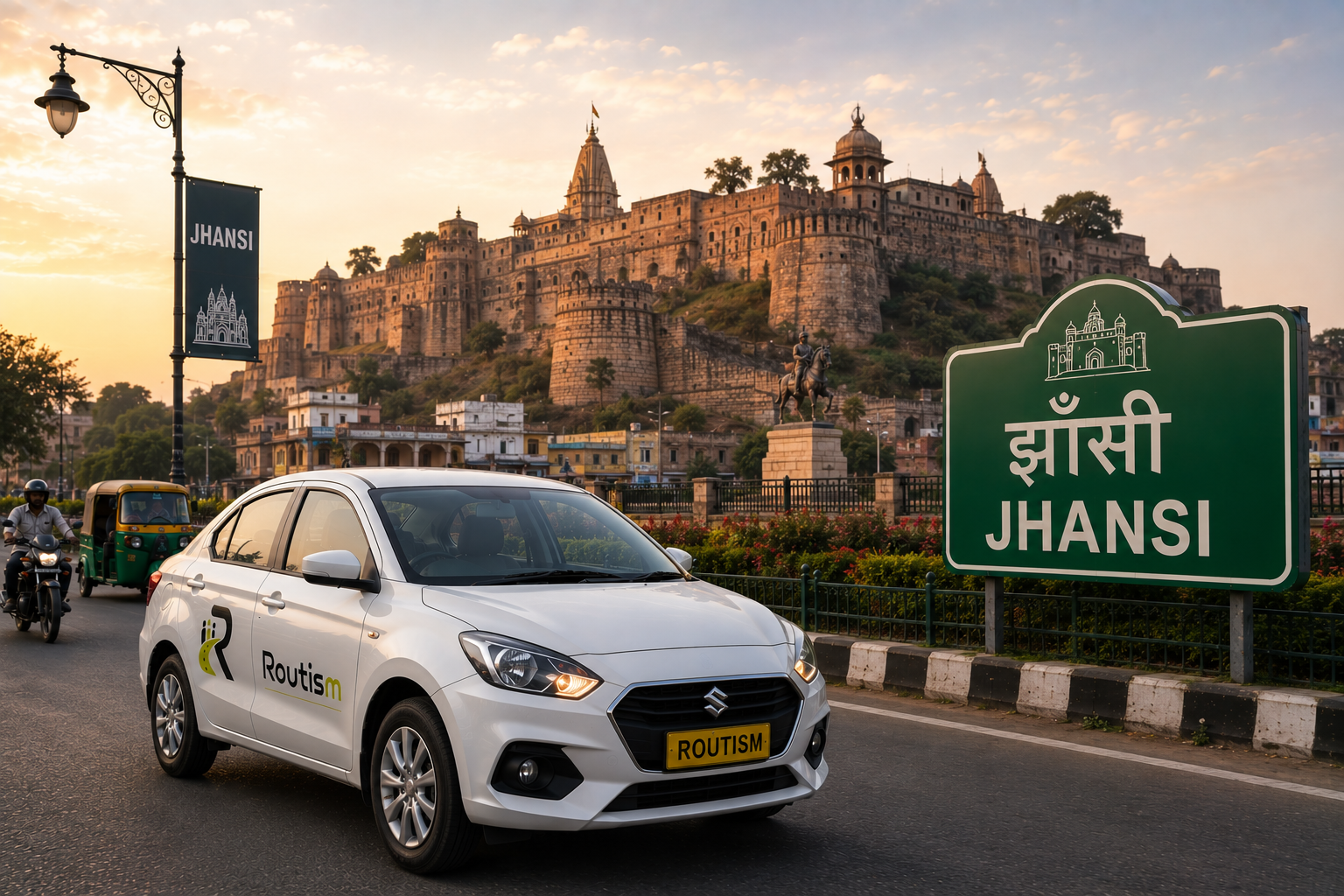
Jhansi, known across India as the city of Rani Lakshmibai and the historic "Gateway to Bundelkhand," sits in the far south of Uttar Pradesh, roughly 292 km from Lucknow and 415 km from Delhi, at the meeting point of the Betwa and Pahuj rivers. With a metro population approaching 710,000 and growing steadily each year, Jhansi has earned a second, more modern nickname too — the "Crossroads of India" — because both the Srinagar-to-Kanyakumari north-south corridor and India's east-west corridor pass directly through the city, making it one of the most strategically positioned transport junctions anywhere in the country.
Routism is a mobility platform that connects customers with verified drivers to make everyday and long-distance travel safe, secure, affordable and convenient, and Jhansi — with its unique mix of heritage tourism, a major railway workforce, and a fast-growing defence manufacturing sector — is exactly the kind of city our network is built to serve. As part of our roadmap to cover all of Uttar Pradesh from our headquarters in Lucknow, join the waiting list to get early access the moment Routism opens matching in Jhansi.
Jhansi's daily mobility pattern is shaped by a combination few other Uttar Pradesh cities share. As a division headquarters of North Central Railway and a stop on the Grand Chord line connecting Delhi, Mumbai, Kolkata and Chennai, Jhansi Junction — now officially renamed Virangana Lakshmibai Jhansi Junction — handled over 8.5 million passengers in 2024 alone, an average of roughly 23,000 people passing through every single day. On top of that, Jhansi has been designated one of six nodes in the Uttar Pradesh Defence Industrial Corridor, specifically as the Centre for Ammunition and Explosives, with sixteen companies now allotted more than 531 hectares of land and investment proposals worth over ₹9,139 crore — a manufacturing buildout that's steadily growing the city's industrial workforce and, with it, its daily commute demand.
Add in Jhansi's role as a genuine heritage tourism destination — home to the historic Jhansi Fort and closely linked to the nearby palace town of Orchha — and the result is a city with three distinct, overlapping travel populations: railway passengers needing local transfers, a growing defence-sector workforce commuting daily, and tourists and history enthusiasts visiting the fort and surrounding Bundelkhand sites. Most of this travel today happens through solo, on-the-spot taxi and auto bookings, a pattern that gets slower and less predictable exactly when Jhansi's road network is under the most pressure.
Routism runs on three core booking systems, each suited to how people actually move through Jhansi — whether they're railway travellers, defence-corridor workers, or heritage tourists.
Book a ride to match your exact need, with competitive fares and rating-based transparency behind every driver.
Shared Booking matches customers travelling on similar Jhansi routes at similar times. Enter your pickup and drop-off, and Routism identifies compatible co-riders heading the same way — for a railway station transfer, a defence-corridor commute, or a long intercity drive to Lucknow or Kanpur. When a match is available, co-riders join the same booking and split the cost between them.
Shared Booking helps to split travel costs, make journeys more affordable, reduce unnecessary empty seats, improve overall vehicle utilisation, potentially reduce the number of vehicles needed on the same route, ease traffic congestion around Jhansi Junction during peak train arrival times, and turn a routine transfer into a more connected, social way of travelling. It supports local, one-way, outstation and round-trip journeys, depending on route compatibility — same direction, same journey, less cost, better utilisation.
Daily Commute is built for people who travel the same Jhansi route at the same time, day after day — railway employees, defence corridor and manufacturing workers, students at the city's medical, engineering and science colleges, and any other regular commuter making the same journey repeatedly. Instead of creating a fresh booking every day, set up a recurring booking for multiple days at once. Routism connects you with suitable drivers and co-commuters on a compatible route and schedule, with route matching, time matching, daily reminders and a predictable, reliable arrangement for everyday commuting — a real commute partner instead of a different arrangement every single week. The recurring booking continues until you or your driver cancels it.
For customers: stop searching for the same ride every day — set your route once and commute with ease. For drivers: build regular customers and spend less time searching for new bookings every day.
Jhansi's defining landmark, the Jhansi Fort, crowns a rocky hilltop above the old walled city and stands as one of the most significant heritage sites connected to Rani Lakshmibai's stand against the British during the 1857 uprising — she ruled the princely state of Jhansi from June 1857 to June 1858 before her death in battle became one of the defining stories of India's independence movement. The fort and the surrounding old city, along with memorials to Lakshmibai and her general Jhalkaribai, form Jhansi's core heritage circuit, each easily reachable with a straightforward Local Ride. Many visitors also extend their trip to nearby Orchha, a beautifully preserved 16th-century palace town on the Betwa river roughly 20 km from Jhansi, making a Round-Trip Ride a natural fit for a full-day heritage excursion.
Jhansi's transport network reflects its unusual strategic position at the crossing of two of India's major national corridors. Virangana Lakshmibai Jhansi Junction, a division headquarters of North Central Railway, sits on the historic Grand Chord line and the Jhansi–Manikpur line, connecting the city directly to Delhi, Mumbai, Kolkata, Chennai, Lucknow and Gorakhpur, with premium trains including Rajdhani services routinely using the station for crew changes given its central location. On the road, five National Highways — NH-12A, NH-25, NH-26, NH-75 and NH-76 — converge on Jhansi, a rare concentration that has earned the city its "Crossroads of India" nickname. The nearest operational civilian airport is Gwalior Airport, about 100 km away, while a long-planned greenfield airport for Jhansi itself remains part of the city's broader infrastructure development plans, alongside a military aviation base dating to the British era.
For travellers arriving at any of these points, a verified Routism Ride or a cost-split Shared Booking is a more predictable way to complete the journey to your hotel, the fort, or a defence-corridor worksite than negotiating a fresh fare at every stop.
Jhansi's position at the crossing of two national highway corridors makes Outstation Rides and Shared Booking especially useful here. Jhansi to Lucknow, roughly 292 km, connects Bundelkhand's largest city to the state capital, carrying steady business, administrative and family traffic. Jhansi to Kanpur links two of Uttar Pradesh's defence-corridor nodes along a well-travelled business route. Jhansi to Gwalior, just across the state border in Madhya Pradesh, sees consistent short-haul travel given Gwalior's role as Jhansi's nearest major airport. Jhansi to Orchha, though a shorter trip, is one of the most consistently booked day-excursion routes in the region.
Instead of paying full fare for a solo cab across any of these routes, a traveller can book an Outstation Ride directly, or join a Shared Booking with another traveller already heading the same way — turning one drive into a shared, more affordable trip for everyone on it. Round-Trip Rides cover the same corridor out and back in a single booking, useful for a same-day Jhansi-to-Lucknow business trip. Read more about the broader Uttar Pradesh intercity network on the Uttar Pradesh state page, and see how the corridor works from the other end on the Lucknow city page.
Jhansi's designation as the Centre for Ammunition and Explosives within the Uttar Pradesh Defence Industrial Corridor is reshaping the city's daily commute in real time. With sixteen companies now allotted land across more than 531 hectares and investment proposals exceeding ₹9,139 crore, the corridor is steadily building a manufacturing workforce that needs to travel fixed routes to fixed worksites at fixed shift times — exactly the pattern Daily Commute is designed around. A shared commute for a group of corridor workers, or an office team commuting from the same residential neighbourhood, can meaningfully cut what each person spends on daily transport, a benefit that will only grow more valuable as the corridor's workforce continues to expand alongside the ₹28,809 crore already invested across all six defence corridor nodes statewide.
Jhansi's story stretches back to 1613, when it was founded by the Raja of Orchha, and grew into the capital of a Maratha-ruled princely state from 1817 until the British annexation in 1854 — a decision that set the stage for Rani Lakshmibai's legendary defence of the city during the Revolt of 1857, a chapter of Indian history taught in classrooms across the country to this day. That legacy still shapes how the city sees itself, but Jhansi's more recent chapters are just as significant to its daily life: the city was ranked the third cleanest in Uttar Pradesh and the fastest-moving city in the North Zone under the Swachh Survekshan 2018 rankings, was selected in 2011 among India's first cohort of Smart Cities, and continues to see steady infrastructure and real estate investment driven by its position on two of India's most important national highway corridors.
That combination of heritage identity and modern industrial ambition is precisely why Jhansi's daily travel needs are evolving so quickly. A city built around a fort and a railway junction is now also building a defence manufacturing base employing thousands, alongside a tourism sector drawing history enthusiasts from across the country — and all of it depends on local roads that, as in most fast-growing Uttar Pradesh cities, need better use of existing vehicles as much as they need new infrastructure.
Verified drivers. Every driver on Routism goes through a verification process before their profile can accept a booking, so Jhansi customers connect with people who have actually been checked.
Affordable travel. Competitive fares across Rides, plus cost-splitting through Shared Booking, help Jhansi's commuters, railway travellers and tourists reduce what they spend without giving up convenience.
Flexible booking. Choose between Local, One-Way, Outstation or Round-Trip Rides, a Shared Booking, or a recurring Daily Commute — whatever the trip actually needs, whether it's a defence-corridor shift or a Lucknow business trip.
Ratings and trust. Customer and driver ratings build transparency and accountability into every match, so decisions about who to travel with in Jhansi are based on real signals, not guesswork.
Better vehicle utilisation. Shared bookings make fuller use of the seats already on Jhansi's roads, instead of adding more half-empty vehicles to an already busy railway junction and highway crossroads.
Recurring connections. Daily Commute lets Jhansi's railway staff, defence-corridor workers and students build long-term travel relationships instead of repeatedly searching for a new booking every single day.
Trust is the entire premise of shared travel, so it's built into every layer of Routism rather than left to chance. Every driver completes verification before their profile can accept a booking. Fares are transparent and agreed before the trip starts — never haggled over on the roadside once you're already committed. And ratings from both customers and drivers keep the whole Jhansi community accountable over time. Full detail on this process is on the how it works page, and specific questions are answered on the FAQ.
Most Jhansi residents and visitors currently choose between several options for any given trip: drive alone, book a full-fare solo cab or auto, or rely on informal shared tempos and city buses for local trips. Each has a real drawback. Driving alone means covering fuel, tolls and parking by yourself in a car with empty seats. A solo cab means paying full fare for a trip that could easily be shared — a particular pain point for the roughly 23,000 people passing through Jhansi Junction every day, most of whom need a final local leg to reach their actual destination. And informal shared tempos, while cheap, offer no verification, no fixed fare, and no reliability from one day to the next.
Routism sits in between: close to the door-to-door convenience of a private vehicle, at a fraction of the cost of travelling alone, with verification and a rating system that neither an informal shared tempo nor a random roadside negotiation can reliably offer.
The process is short, whether you're commuting daily to a defence-corridor worksite or planning a one-off Outstation Ride to Lucknow:
For now, the first step is the waiting list — it's how early access, founding member status and route priority get decided as Jhansi's matching network comes online.
No places have been published for this city yet.
Common questions about Smart, Safe & Affordable Mobility in Jhansi — Routism.
Is Routism available in Jhansi yet? Jhansi is part of Routism's Uttar Pradesh expansion roadmap, following our launch in Lucknow. Join the waiting list for early access as matching opens in the city.
Can Routism help with railway station transfers in Jhansi? Yes — One-Way and Local Rides are built exactly for transfers from Virangana Lakshmibai Jhansi Junction to your hotel, business address or Jhansi Fort.
Can I book a shared ride from Jhansi to Lucknow? Yes — Outstation Rides and Shared Booking both cover the Jhansi–Lucknow corridor, along with routes to Kanpur, Gwalior and Orchha. See the Lucknow city page and the Uttar Pradesh state page for more on these corridors.
Is there a Routism option for defence corridor shift workers in Jhansi? Yes — Daily Commute matches you with riders and drivers whose route and shift timing genuinely overlap, which fits Jhansi's growing defence manufacturing workforce as well as standard office commutes.
How does Routism keep rides in Jhansi safe? Every driver completes a verification process before a booking is offered, fares are transparent and agreed upfront, and a customer-and-driver rating system keeps the community accountable. Details are on the how it works and FAQ pages.
Can I book a day trip to Orchha from Jhansi? Yes — Round-Trip Rides cover the onward and return journey together in a single booking, ideal for a full-day heritage excursion to Orchha and back.
Routism — safe journeys, smart connections, better mobility. Starting from Lucknow. Available across Uttar Pradesh.
Join the waiting list with your name, mobile number, email and route to get early access the moment Routism opens in Jhansi. Explore the broader network on the Uttar Pradesh state page, see how the Jhansi–Lucknow corridor works from our headquarters city on the Lucknow page, or read how Routism works.
End of Jhansi city page content.