Verified Rides, Shared Booking and Daily Commute across Braj Bhoomi — temple-hopping transfers between Mathura, Vrindavan and beyond, all on Routism.
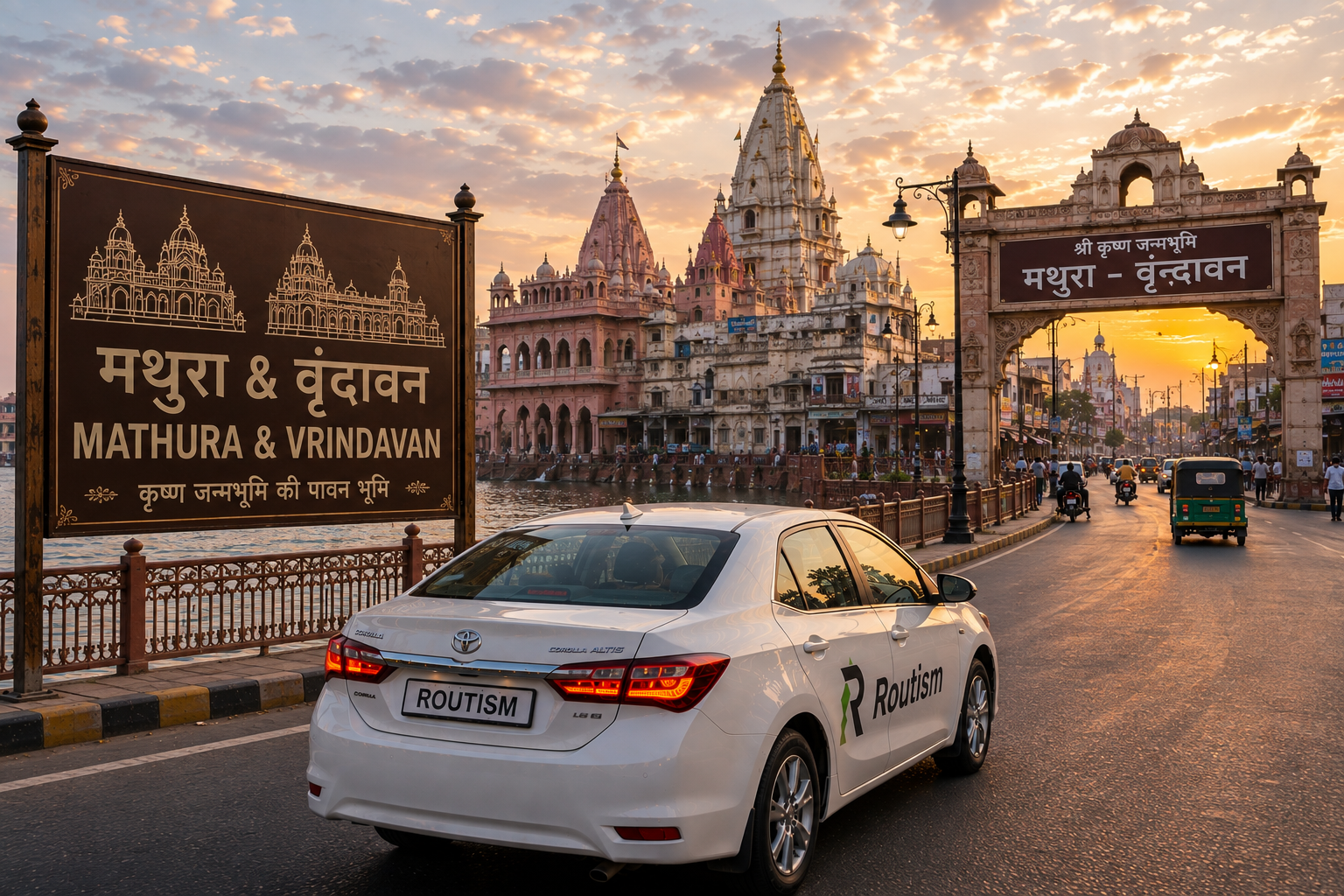
Mathura and Vrindavan, twin cities just 12–14 km apart in western Uttar Pradesh, together form the spiritual heart of Braj Bhoomi — the land of Lord Krishna's birth and childhood, and one of the most continuously visited pilgrimage circuits in India. Mathura, the birthplace of Krishna and one of Hinduism's seven sacred Sapta Puri cities, is home to an estimated 680,000–766,000 people in 2026, while neighbouring Vrindavan, a much smaller town of around 63,000 residents packed with more than 5,000 temples across just five square kilometres, draws a scale of daily pilgrim footfall that dwarfs its own population many times over, especially around festivals like Janmashtami and the world-famous Lathmar Holi at nearby Barsana and Nandgaon.
Routism is a mobility platform that connects customers with verified drivers to make everyday and long-distance travel safe, secure, affordable and convenient, and the Mathura–Vrindavan circuit — with its dense temple-hopping pilgrim traffic, a short but heavily travelled inter-city gap, and connections onward to Govardhan, Barsana, Gokul and beyond — is exactly the kind of destination our network is built to serve. As part of our roadmap to cover all of Uttar Pradesh from our headquarters in Lucknow, join the waiting list to get early access the moment Routism opens matching in Mathura & Vrindavan.
The core mobility challenge here is unlike almost anywhere else on Routism's roadmap: two cities, a short 12–14 km apart, that nearly every visitor needs to travel between multiple times over one or two days, on top of dense local temple-to-temple movement within each town. A typical pilgrim itinerary runs from Krishna Janmabhoomi to Dwarkadhish Temple and Vishram Ghat in Mathura, then on to ISKCON, Banke Bihari, Nidhivan and Prem Mandir in Vrindavan — a sequence that means multiple short trips, often timed tightly around specific aarti schedules, several times over the course of a single day.
Most pilgrims currently piece this together through auto-rickshaws negotiated stop-by-stop, or a single full-day taxi hire that one traveller pays for alone even when the car has three empty seats and other visitors on the same route. That pattern gets significantly worse during peak periods — weekends, Janmashtami, and especially Holi season, when Barsana's Lathmar Holi and Vrindavan's flower Holi at Banke Bihari draw crowds that regularly overwhelm local auto and taxi availability.
Routism runs on three core booking systems, each suited to how people actually move through this compact but temple-dense circuit.
Book a ride to match your exact need, with competitive fares and rating-based transparency behind every driver.
Shared Booking matches customers travelling on similar Mathura–Vrindavan routes at similar times. Enter your pickup and drop-off, and Routism identifies compatible co-riders heading the same way — for the short Mathura-to-Vrindavan hop, a temple-circuit tour, or a longer drive to Agra or Delhi. When a match is available, co-riders join the same booking and split the cost between them.
Shared Booking helps to split travel costs, make journeys more affordable, reduce unnecessary empty seats, improve overall vehicle utilisation, potentially reduce the number of vehicles needed on the same route, ease traffic congestion during Holi and Janmashtami peaks, and turn a solo pilgrim transfer into a more connected, social way of travelling. It supports local, one-way, outstation and round-trip journeys, depending on route compatibility — same direction, same journey, less cost, better utilisation.
Not everyone in Mathura and Vrindavan is a pilgrim. Daily Commute is built for residents, ashram and temple staff, shopkeepers, students and professionals who travel the same route at the same time, day after day — including the many who commute daily between the two towns for work. Instead of creating a fresh booking every day, set up a recurring booking for multiple days at once. Routism connects you with suitable drivers and co-commuters on a compatible route and schedule, with route matching, time matching, daily reminders and a predictable, reliable arrangement for everyday travel. The recurring booking continues until you or your driver cancels it.
For customers: stop searching for the same ride every day — set your route once and commute with ease. For drivers based in the region: build regular customers between pilgrim seasons and spend less time searching for new bookings every day.
The classic Braj Bhoomi circuit runs a well-worn but genuinely rewarding path. In Mathura, most journeys begin at Krishna Janmabhoomi, the temple complex built over the traditionally identified birthplace of Krishna, before continuing to the grand Dwarkadhish Temple and the riverside Vishram Ghat on the Yamuna, famous for its evening aarti. The short drive to Vrindavan — typically 20–30 minutes depending on traffic — opens up a town of more than 5,000 temples, anchored by the 600-year-old Banke Bihari Temple with its distinctive curtain-veiled darshan, the internationally popular ISKCON Krishna Balaram Mandir founded in 1975, the dazzling marble Prem Mandir with its evening light show, and quieter spots like Nidhivan and Kesi Ghat, known for one of Braj's loveliest sunset aartis.
Many visitors extend their trip further into the wider Braj region — to Gokul and Mahavan, associated with Krishna's infancy, to Govardhan Hill with its Kusum Sarovar and Radha Kund, and to Barsana and Nandgaon, the legendary towns of Radha and Krishna best known today for their raucous, joyful Lathmar Holi celebrations. Each of these stops is easily covered with a Local or Round-Trip Ride instead of negotiating a fresh auto fare at every gate.
Mathura and Vrindavan are well connected but rely almost entirely on road transport for the final leg of any journey. The nearest airport is at Agra, roughly 54–58 km away, with Delhi's international airport a further option at around 150 km via the Yamuna Expressway. On rail, Mathura Junction is the region's major railway hub, connecting the city directly to Delhi, Agra, Lucknow and destinations across India; Vrindavan's own historic metre-gauge branch line, which opened in 1889, has been closed since 2023, meaning nearly all Vrindavan-bound travellers now arrive via Mathura and complete the final 12–14 km by road. UPSRTC buses also run regular services into Mathura from Delhi, Lucknow, Varanasi and other major Uttar Pradesh cities.
For travellers arriving at any of these points, especially first-time pilgrims unfamiliar with fair local rates, a verified Routism Ride or a cost-split Shared Booking is a far more predictable way to complete the journey into Mathura, on to Vrindavan, and around the wider temple circuit — particularly now that every Vrindavan-bound rail passenger depends entirely on that final road leg.
Sitting roughly 145–160 km from Delhi and about 50 km from Agra, Mathura is a natural hub for several major intercity corridors. Mathura to Agra, linking two of the Golden Triangle's most visited destinations, carries constant tourist and pilgrim traffic. Mathura to Delhi, via the Yamuna Expressway, is one of the busiest short-haul pilgrim and business corridors in the region. Mathura to Lucknow connects Braj Bhoomi to the state capital for longer administrative and family journeys. And the short but essential Mathura to Vrindavan hop, along with onward trips to Govardhan and Barsana, rounds out the wider Braj circuit that most visitors want covered in a single, well-organised trip rather than a series of separate negotiations.
Instead of paying full fare for a solo taxi across any of these routes, a traveller can book an Outstation Ride directly, or join a Shared Booking with another pilgrim already heading the same way — turning one drive into a shared, more affordable trip for everyone on it. Round-Trip Rides cover the same route out and back in a single booking, ideal for a full-day Braj Bhoomi circuit. Read more about the broader Uttar Pradesh intercity network on the Uttar Pradesh state page, and see how the corridor works from the other end on the Lucknow city page.
Few pilgrimage circuits in India have a festival calendar as intense as Braj Bhoomi's. Janmashtami, celebrating Krishna's birth, is the single biggest event of the year, with the Krishna Janmabhoomi idol bathed in panchamrit at midnight before hundreds of thousands of devotees, and ISKCON Vrindavan running its own dramatic midnight birth ceremony and free mahaprasad feast. Holi, in March, is world-famous here in ways found nowhere else in India — Lathmar Holi at Barsana and Nandgaon, where women playfully beat men with sticks in a joyous re-enactment of Krishna and Radha's courtship, and flower Holi at Banke Bihari Temple, both drawing enormous crowds well beyond the region's normal daily footfall. Basant Panchami marks the start of the Holi season each spring, and even ordinary weekends bring noticeably heavier crowds than weekdays across the temple circuit.
These are exactly the periods when informal, on-the-spot travel arrangements break down hardest — auto and taxi rates climb, and drivers unfamiliar with a pilgrim's actual plan can turn a simple temple hop into a frustrating negotiation. A pre-agreed Routism Ride or Shared Booking, arranged before you arrive rather than negotiated in the crush of a festival crowd, is a far more predictable way to move through Braj Bhoomi when it matters most.
Verified drivers. Every driver on Routism goes through a verification process before their profile can accept a booking, which matters even more on a circuit where the vast majority of travellers are visiting for the first time and don't know local routes or fair fares.
Affordable travel. Competitive fares across Rides, plus cost-splitting through Shared Booking, help pilgrims and residents alike reduce what they spend on the many short hops a Braj Bhoomi visit typically requires.
Flexible booking. Choose between Local, One-Way, Outstation or Round-Trip Rides, a Shared Booking, or a recurring Daily Commute — whatever the trip actually needs, whether you're visiting for a single darshan or living and working across the two towns.
Ratings and trust. Customer and driver ratings build transparency and accountability into every match, giving first-time visitors a real signal of who they're travelling with.
Better vehicle utilisation. Shared bookings make fuller use of the vehicles already moving along the short, heavily travelled Mathura–Vrindavan corridor, instead of adding more half-empty cars to an already-busy stretch during peak festival periods.
Recurring connections. Daily Commute lets residents, ashram staff and daily workers who move between Mathura and Vrindavan build long-term travel relationships instead of repeatedly searching for a new booking every single day.
Trust matters enormously on a circuit where nearly every traveller is unfamiliar with local routes, fair fares and trustworthy drivers. Every driver on Routism completes verification before their profile can accept a booking. Fares are transparent and agreed before the trip starts — never haggled over on the roadside, which is especially valuable during Holi and Janmashtami when demand-driven price spikes are common. And ratings from both customers and drivers keep the whole Braj Bhoomi travel community accountable over time. Full detail on this process is on the how it works page, and specific questions are answered on the FAQ.
Most pilgrims today choose between a few options: negotiate an auto-rickshaw fare stop by stop through the temple circuit, book a full-day private taxi package through a local operator, or hire a cycle-rickshaw for short hops within Vrindavan's narrow lanes. Each has a real drawback. Stop-by-stop negotiation means paying whatever the moment's demand allows at every single gate. A full-day taxi package usually means paying alone, even when other travellers on your train are heading to the exact same temples. And while cycle-rickshaws suit Vrindavan's narrow inner lanes well, they offer no verification and no fixed fare for anything beyond a short local hop.
Routism sits in between: close to the door-to-door convenience of a private taxi, at a fraction of the cost when a Shared Booking match is available, with driver verification and a rating system that neither roadside negotiation nor an unfamiliar local operator can reliably offer.
The process is short, whether you're a pilgrim in town for a single day or a resident commuting between the two towns:
For now, the first step is the waiting list — it's how early access, founding member status and route priority get decided as the Braj Bhoomi matching network comes online.
Common questions about Smart, Safe & Affordable Mobility in Mathura & Vrindavan — Routism.
Is Routism available in Mathura & Vrindavan yet? Mathura and Vrindavan are part of Routism's Uttar Pradesh expansion roadmap, following our launch in Lucknow. Join the waiting list for early access as matching opens in the region.
Can Routism help me get between Mathura and Vrindavan? Yes — the short but heavily travelled Mathura-to-Vrindavan hop is exactly what Local and Round-Trip Rides, along with Shared Booking, are built for.
Can I book a shared ride from Mathura to Agra or Delhi? Yes — Outstation Rides and Shared Booking both cover the Mathura–Agra and Mathura–Delhi corridors, along with routes to Lucknow. See the Lucknow city page and the Uttar Pradesh state page for more on these corridors.
Is Routism useful outside Janmashtami and Holi season? Yes — Daily Commute is built for residents, temple staff and daily workers who need reliable local travel year-round, not just during the region's major festivals.
How does Routism keep rides safe for pilgrims unfamiliar with Mathura & Vrindavan? Every driver completes a verification process before a booking is offered, fares are transparent and agreed upfront rather than negotiated on arrival, and a customer-and-driver rating system keeps the community accountable. Details are on the how it works and FAQ pages.
Can I book a full-day round trip covering the whole temple circuit? Yes — Round-Trip Rides cover the onward and return journey together in a single booking, ideal for a full-day Mathura–Vrindavan temple circuit or an extended trip out to Govardhan and Barsana.
Routism — safe journeys, smart connections, better mobility. Starting from Lucknow. Available across Uttar Pradesh.
Join the waiting list with your name, mobile number, email and route to get early access the moment Routism opens in Mathura & Vrindavan. Explore the broader network on the Uttar Pradesh state page, see how the Mathura–Lucknow corridor works from our headquarters city on the Lucknow page, or read how Routism works.
End of Mathura & Vrindavan city page content.