Verified Rides, Shared Booking and Daily Commute in Meerut — local travel, RRTS-connected commutes and intercity trips to Lucknow & Delhi on Routism.
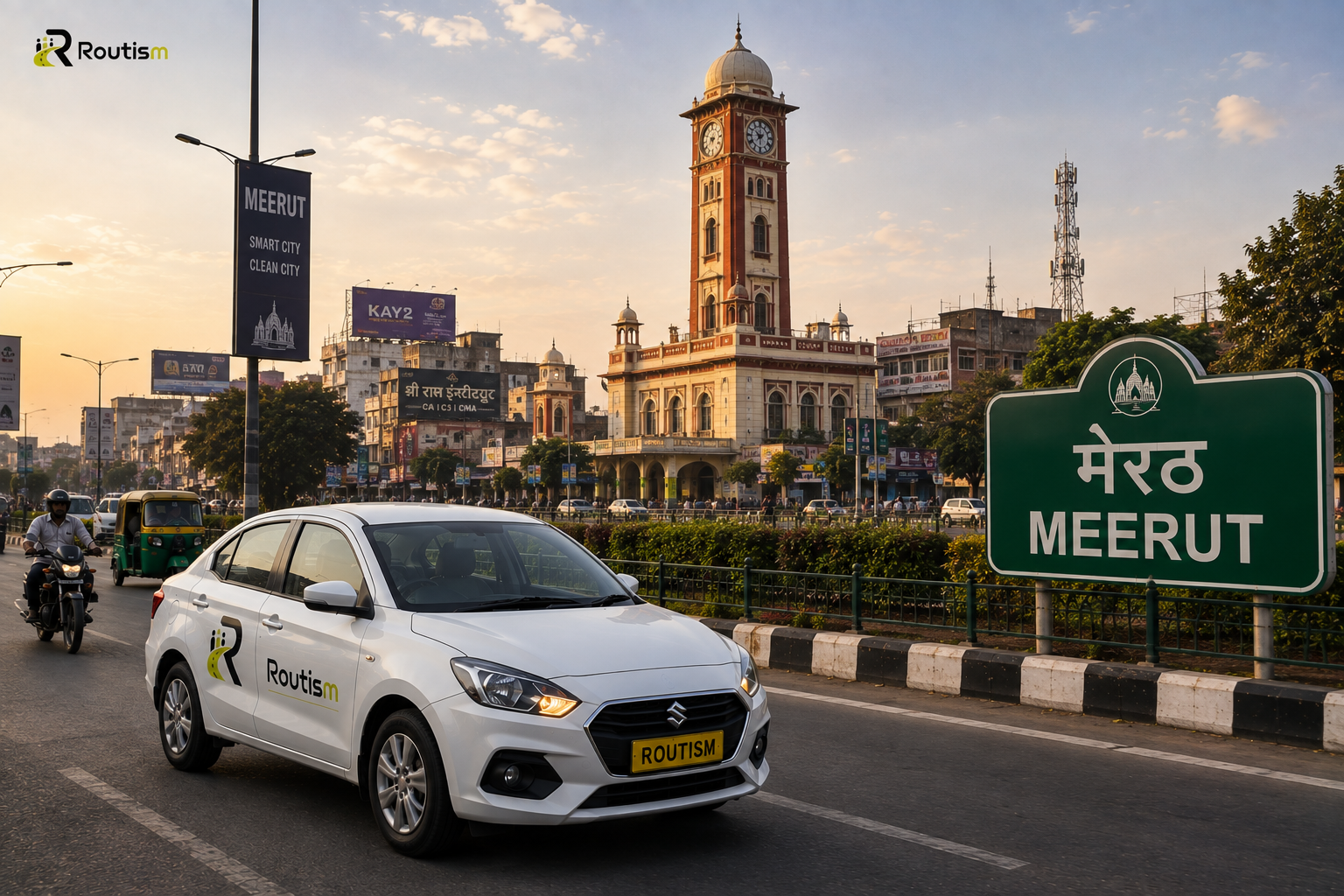
Meerut, an ancient cantonment city in western Uttar Pradesh now home to an estimated 1.96 million people in the city and over 2.1 million across its urban region, has quietly become the second-largest city in the entire National Capital Region after Delhi itself — and the fastest-developing city in Uttar Pradesh behind Noida and Ghaziabad. Known worldwide as the sports capital of India — home to global sports goods manufacturers producing roughly 40% of India's cricket and football equipment — Meerut has spent the last few years going through one of the biggest infrastructure transformations of any city on our roadmap, anchored by the historic Delhi–Meerut Regional Rapid Transit System (RRTS).
Routism is a mobility platform that connects customers with verified drivers to make everyday and long-distance travel safe, secure, affordable and convenient, and Meerut — with its dense industrial base, its tight daily ties to Delhi, and its brand-new high-speed rail backbone — is exactly the kind of city our network is built to serve. As part of our plan to cover all of Uttar Pradesh from our headquarters in Lucknow, join the waiting list to get early access the moment Routism opens matching in Meerut.
Meerut's daily mobility challenge has a very specific shape: thousands of residents travelling daily between Meerut and Delhi for work, education and business, layered on top of a large local industrial workforce in sports goods, metal work and agricultural trade, all moving through a road network that struggled for years to keep pace with the city's rapid population and business growth. That pressure is exactly what drove the construction of the Delhi–Meerut RRTS in the first place — a project built specifically because so many people were making the Delhi–Meerut journey by road every single day that the region needed an entirely new transit system to absorb it.
That system reached a major milestone on 22 February 2026, when the full 82-km Namo Bharat corridor from Sarai Kale Khan to Modipuram opened alongside the new Meerut Metro, recording over 100,000 riders on its very first full day of combined operation — the highest single-day ridership the corridor had ever seen, and a shift NCRTC says has moved public transport's share of Delhi–Meerut travel from 37% to 63% almost overnight. That's a genuine transformation, but even with a world-class rail spine now in place, Meerut's local roads, industrial estates and residential colonies still depend on road-based transport for nearly every trip that doesn't start and end exactly at an RRTS or Metro station.
Routism runs on three core booking systems, each suited to a different part of how Meerut actually moves.
Book a ride to match your exact need, with competitive fares and rating-based transparency behind every driver.
Shared Booking matches customers travelling on similar Meerut routes at similar times. Enter your pickup and drop-off, and Routism identifies compatible co-riders heading the same way — for a cross-city commute to an industrial estate, a station transfer, or a long intercity drive to Lucknow or Delhi. When a match is available, co-riders join the same booking and split the cost between them.
Shared Booking helps to split travel costs, make journeys more affordable, reduce unnecessary empty seats, improve overall vehicle utilisation, potentially reduce the number of vehicles required on the same route, ease traffic congestion on Meerut's busiest local corridors, and turn a routine local commute into a more connected, social way of travelling. It supports local, one-way, outstation and round-trip journeys, depending on route compatibility — same direction, same journey, less cost, better utilisation.
Daily Commute is built for people who travel the same Meerut route at the same time, day after day — sports goods factory and workshop staff, cantonment-area employees, students, teachers, and any other regular commuter making the same journey repeatedly. Instead of creating a fresh booking every day, set up a recurring booking for multiple days at once. Routism connects you with suitable drivers and co-commuters on a compatible route and schedule, with route matching, time matching, daily reminders and a predictable, reliable arrangement for everyday commuting — a real commute partner instead of a different arrangement every single week. The recurring booking continues until you or your driver cancels it.
For customers: stop searching for the same ride every day — set your route once and commute with ease. For drivers: build regular customers and spend less time searching for new bookings every day.
Meerut's daily travel spans a wide mix of historic, industrial and rapidly developing zones. Meerut Cantonment, one of the largest cantonment areas in the country by both size and population, brings wide roads and a distinct defence-community commute pattern. Sadar Bazaar, the city's historic commercial core near the railway station, remains dense with markets and heritage buildings. Shastri Nagar, one of Meerut's most established residential areas, and newer well-planned colonies with a mix of residential and commercial space, generate steady daily local travel. The sports-goods manufacturing belt — producing a large share of India's cricket and football equipment — anchors much of the city's industrial workforce commute, while Modipuram, the RRTS and Meerut Metro's northern terminus, is fast becoming a major transit-oriented development hub in its own right.
Popular routes we expect to prioritise at launch: transfers to and from Meerut Central and Modipuram RRTS/Metro stations, cross-city trips between Sadar Bazaar and Shastri Nagar, local travel around the sports-goods industrial belt, and Outstation Rides on Meerut ↔ Delhi and Meerut ↔ Lucknow. Join the waiting list and tell us your own route — it directly shapes which Meerut corridor we switch on first.
Few cities in Uttar Pradesh have seen their transport infrastructure change as fast as Meerut has in the last few years. The Delhi–Meerut RRTS, India's first Namo Bharat semi-high-speed rail corridor, has cut the road journey time between Delhi and Meerut from 2.5–3 hours down to roughly 55–59 minutes, running trains built for speeds up to 180 km/h. The Meerut Metro, integrated directly onto the same corridor at four shared stations — the first such direct metro-and-regional-rail merger in India — opened its first phase in February 2026, covering 23.6 km with 12 stations between Modipuram and Meerut South. Together, the two systems are projected to eventually carry nearly 800,000 daily passengers as ridership matures.
That's a genuinely transformative rail backbone, but it only covers the corridor itself. A trip from a residential colony in Shastri Nagar to the nearest RRTS station, or from Meerut Central to a workshop deep in the sports-goods manufacturing belt, still depends on road transport — and that's exactly the gap a Local or One-Way Ride on Routism is built to close, complementing rather than competing with Meerut's new rail network.
Meerut's position as the NCR's second-largest city, roughly 56 km northeast of Delhi, makes Outstation Rides and Shared Booking especially useful here. Meerut to Delhi is the city's single busiest corridor, now served by both the RRTS and a dense road network including the Delhi–Meerut Expressway, still carrying enormous daily road traffic for journeys and timings the rail corridor doesn't cover door-to-door. Meerut to Ghaziabad and Meerut to Noida see steady daily business and family travel across the western NCR. Meerut to Lucknow, connecting Uttar Pradesh's western industrial hub to its capital, carries business, administrative and family travel along the state's core highway network, further supported by the Ganga Expressway and Meerut–Kanpur Expressway that pass through the city.
Instead of paying full fare for a solo cab, or driving the whole distance alone, a customer can book an Outstation Ride directly, or join a Shared Booking with another traveller already heading the same way — turning one drive into a shared, cheaper trip for everyone on it. Round-Trip Rides cover the same corridor out and back in a single booking, useful for a same-day Meerut-to-Lucknow business trip. Read more about the broader Uttar Pradesh intercity network on the Uttar Pradesh state page, and see how Lucknow anchors that network on the Lucknow city page.
Meerut's global reputation as the "sports capital of India" rests on a dense cluster of manufacturers — including internationally recognised names in cricket and football equipment — spread across roughly 3,500 hectares of industrial land in and around the city. That cluster generates a very large, very predictable daily workforce commute: factory and workshop staff travelling fixed routes at fixed shift times, day after day. This is precisely the pattern Daily Commute is designed around. A shared commute for a group of workshop colleagues, or an office team commuting from the same residential belt into the industrial zone, can meaningfully cut what each person spends on daily transport — while also easing pressure on local roads that, even with RRTS now open, still carry the bulk of Meerut's true door-to-door journeys.
Meerut's history runs far deeper than its current infrastructure boom. It was here, at Meerut Cantonment — now one of the largest cantonment areas in the country by both size and population — that the Revolt of 1857 first broke out, a moment that shaped the city's identity for generations afterward. Landmarks from that era, including St. John's Church, built in 1821, and a Shiva temple that played a pivotal role in the uprising, still stand in the city today, alongside a Victorian-era garden dating to 1817 that remains one of Meerut's most visited public spaces. Layered on top of that heritage core is a rapidly modernising city: new residential colonies, an expanding sports-goods export economy, and now a rail network that has cut its travel time to the national capital by more than half. Few Uttar Pradesh cities are changing shape this quickly, and few need a flexible, verified local mobility option more than one balancing a historic cantonment core against a fast-growing, RRTS-connected future.
Verified drivers. Every driver on Routism goes through a verification process before their profile can accept a booking, so Meerut customers connect with people who have actually been checked.
Affordable travel. Competitive fares across Rides, plus cost-splitting through Shared Booking, help Meerut's daily commuters and industrial workers reduce what they spend without giving up convenience.
Flexible booking. Choose between Local, One-Way, Outstation or Round-Trip Rides, a Shared Booking, or a recurring Daily Commute — whatever the trip actually needs, whether it's an RRTS-station transfer or a Lucknow business trip.
Ratings and trust. Customer and driver ratings build transparency and accountability into every match, so decisions about who to travel with in Meerut are based on real signals, not guesswork.
Better vehicle utilisation. Shared bookings make fuller use of the seats already on Meerut's local roads, instead of adding more half-empty vehicles to an already-growing city.
Recurring connections. Daily Commute lets Meerut's factory workers, office employees and students build long-term travel relationships instead of repeatedly searching for a new booking every single day.
Trust is the entire premise of shared travel, so it's built into every layer of Routism rather than left to chance. Every driver completes verification before their profile can accept a booking. Fares are transparent and agreed before the trip starts — never haggled over on the roadside once you're already committed. And ratings from both customers and drivers keep the whole Meerut community accountable over time. Full detail on this process is on the how it works page, and specific questions are answered on the FAQ.
Most Meerut residents currently choose between several options for any given trip: drive alone, book a full-fare solo cab, take the RRTS or Metro and arrange separate transport at each end, or rely on autos and shared tempos for local trips. Each has a real drawback. Driving alone means covering fuel, tolls and parking by yourself in a car with empty seats. A solo cab means paying full fare for a trip that could easily be shared. And while the RRTS is genuinely excellent for the Delhi corridor itself, it still leaves a first-mile and last-mile gap into Meerut's residential colonies and industrial estates that informal transport fills inconsistently, with no verification and no fixed fare.
Routism sits in between: close to the door-to-door convenience of a private vehicle, at a fraction of the cost of travelling alone, with verification and a rating system that neither an informal shared auto nor a random local arrangement can reliably offer — while complementing, rather than competing with, Meerut's new rapid-rail network for the journeys it doesn't reach directly.
The process is short, whether you're commuting daily to a sports-goods workshop or planning a one-off Outstation Ride to Lucknow:
For now, the first step is the waiting list — it's how early access, founding member status and route priority get decided as Meerut's matching network comes online.
No places have been published for this city yet.
Common questions about Smart, Safe & Affordable Mobility in Meerut — Routism.
Is Routism available in Meerut yet? Meerut is part of Routism's Uttar Pradesh expansion roadmap, following our launch in Lucknow. Join the waiting list for early access as matching opens in the city.
Can Routism help with my daily commute from Meerut into Delhi? Yes — Daily Commute is built for repeat, fixed-schedule journeys, and Local or One-Way Rides can also cover the trip to your nearest RRTS or Metro station for the fast rail leg into Delhi.
Can I book a shared ride from Meerut to Lucknow? Yes — Outstation Rides and Shared Booking both cover the Meerut–Lucknow corridor, along with routes to Delhi, Ghaziabad and Noida. See the Lucknow city page and the Uttar Pradesh state page for more on these corridors.
Does Routism compete with the Delhi–Meerut RRTS or Meerut Metro? No — Routism is designed to complement rail transit, not replace it. Local and One-Way Rides are especially useful for the first-mile and last-mile legs that RRTS and Metro stations don't reach directly.
How does Routism keep rides in Meerut safe? Every driver completes a verification process before a booking is offered, fares are transparent and agreed upfront, and a customer-and-driver rating system keeps the community accountable. Details are on the how it works and FAQ pages.
Is there a Routism option for factory or workshop shift workers in Meerut? Yes — Daily Commute matches you with riders and drivers whose route and shift timing genuinely overlap, which fits Meerut's sports-goods and manufacturing shift patterns as well as standard office commutes.
Routism — safe journeys, smart connections, better mobility. Starting from Lucknow. Available across Uttar Pradesh.
Join the waiting list with your name, mobile number, email and route to get early access the moment Routism opens in Meerut. Explore the broader network on the Uttar Pradesh state page, see how the Meerut–Lucknow corridor works from our headquarters city on the Lucknow page, or read how Routism works.
End of Meerut city page content.