Verified Rides, Shared Booking and Daily Commute in Noida — IT-sector commutes, Jewar Airport transfers and intercity trips to Lucknow, all on Routism.
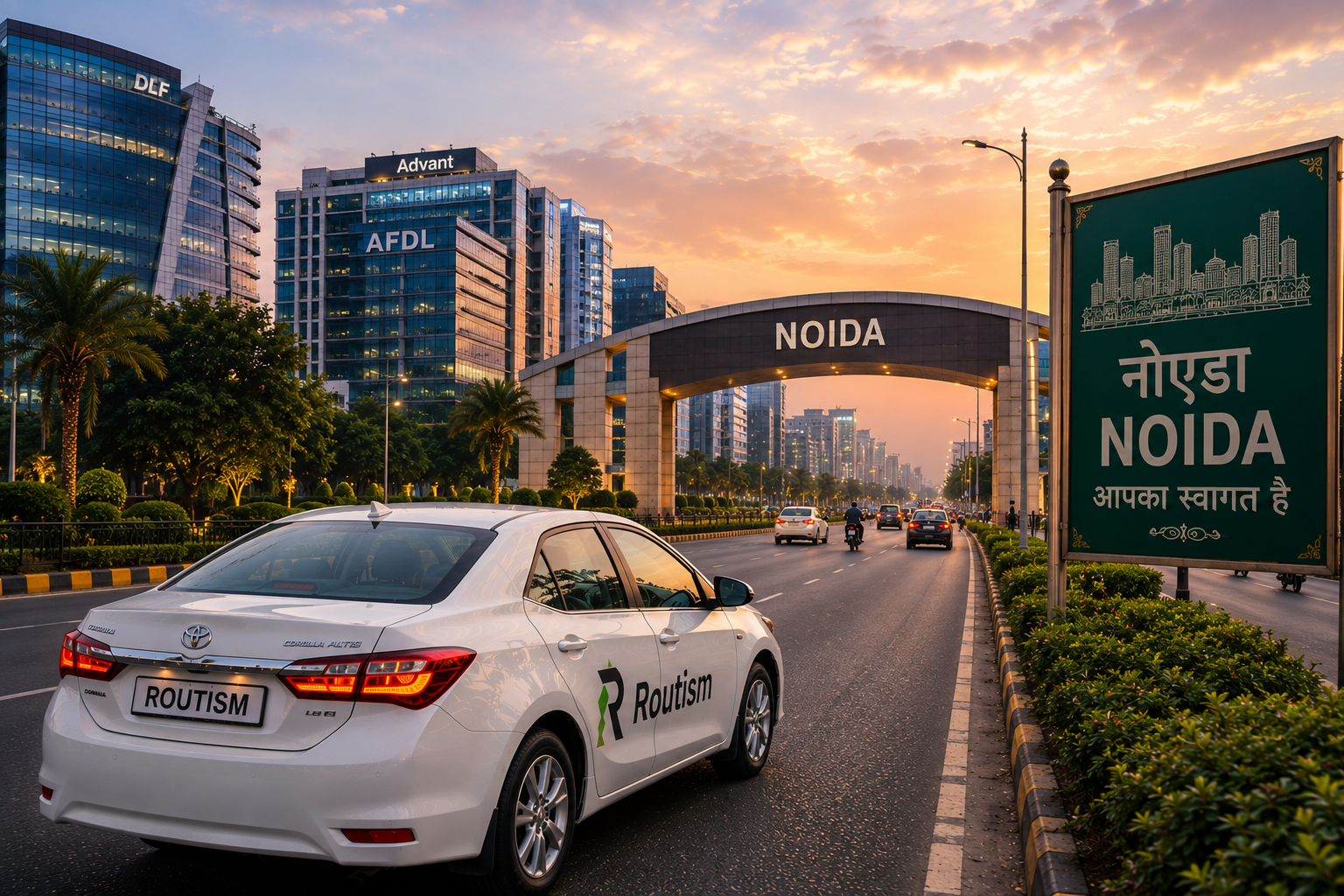
Noida, formally New Okhla Industrial Development Authority, is Uttar Pradesh's most prominent NCR satellite city and one of India's largest IT and services hubs, home to a dense cluster of corporate campuses, business parks and residential sectors that have grown almost continuously since the city's founding. Sector 62 alone functions as a major job centre packed with IT and corporate business parks, connected by the Delhi Metro's Blue Line and a growing web of expressways, while sectors like 18, 74, 93 and 137 round out the city's mix of commercial, residential and lifestyle zones. As 2026 unfolds, Noida has also become the launch site for one of India's most significant new pieces of infrastructure — Noida International Airport at Jewar — putting the city at the centre of a fresh wave of connectivity investment across the whole NCR.
Routism is a mobility platform that connects customers with verified drivers to make everyday and long-distance travel safe, secure, affordable and convenient, and Noida — with its massive daily IT-sector commute, its dense expressway and metro network, and its brand-new international airport — is exactly the kind of city our network is built to serve. As part of our roadmap to cover all of Uttar Pradesh from our headquarters in Lucknow, join the waiting list to get early access the moment Routism opens matching in Noida.
Noida's daily mobility challenge comes from the sheer density of its office economy. Sector 62 alone hosts sprawling IT campuses and corporate parks that draw workers from Noida, Ghaziabad, East Delhi and beyond, with commute times that can drop to as little as 10–20 minutes for those living nearby, but stretch considerably further for anyone travelling in from outside the immediate sector — especially along the NH-24 stretch, which residents routinely describe as heavily congested during office hours. That pattern repeats across Noida's other major office clusters, all converging on a handful of arterial roads and metro corridors that carry an enormous daily volume of commuter traffic.
Layered on top of this established IT-commute pattern is the sudden arrival of Noida International Airport at Jewar, which began commercial flight operations on 15 June 2026 after being inaugurated by the Prime Minister that March. The airport sits roughly 56 km from central Noida and around 60–70 minutes from Sector 18 in typical traffic, reachable via the Yamuna Expressway — a genuinely new travel pattern that didn't exist in Noida a year ago, and one that's already reshaping how residents, businesses and travellers think about getting in and out of the city.
Routism runs on three core booking systems, each suited to how people actually move through Noida — whether they're IT professionals, students, or travellers connecting to the city's new airport.
Book a ride to match your exact need, with competitive fares and rating-based transparency behind every driver.
Shared Booking matches customers travelling on similar Noida routes at similar times. Enter your pickup and drop-off, and Routism identifies compatible co-riders heading the same way — for a daily IT-park commute, a Jewar Airport transfer, or a long intercity drive to Lucknow. When a match is available, co-riders join the same booking and split the cost between them.
Shared Booking helps to split travel costs, make journeys more affordable, reduce unnecessary empty seats, improve overall vehicle utilisation, potentially reduce the number of vehicles needed on the same route, ease traffic congestion on Noida's busiest commercial corridors, and turn a routine office commute into a more connected, social way of travelling. It supports local, one-way, outstation and round-trip journeys, depending on route compatibility — same direction, same journey, less cost, better utilisation.
Daily Commute is built for people who travel the same Noida route at the same time, day after day — IT and corporate professionals, students, teachers, and any other regular commuter making the same journey repeatedly. Instead of creating a fresh booking every day, set up a recurring booking for multiple days at once. Routism connects you with suitable drivers and co-commuters on a compatible route and schedule, with route matching, time matching, daily reminders and a predictable, reliable arrangement for everyday commuting — a real commute partner for the Sector 62-to-Sector 18 run, or any daily route across the city, instead of a different arrangement every single week. The recurring booking continues until you or your driver cancels it.
For customers: stop searching for the same ride every day — set your route once and commute with ease. For drivers: build regular customers and spend less time searching for new bookings every day.
Noida's daily travel spans a dense grid of numbered sectors, each with its own character. Sector 62 is widely described as Noida's IT hub, packed with corporate campuses and business parks, connected via the Blue Line's Noida Electronic City metro station and NH-24. Sector 18 functions as the city's commercial and entertainment heart, home to major malls and a dense retail and dining scene. Sectors 74, 78, 93 and 137 round out the city's other major residential-and-office clusters, popular with young professionals for their mix of expressway access and modern housing. Further out, Greater Noida and its landmark junction at Pari Chowk anchor the city's southern expansion, now increasingly tied to Jewar Airport traffic as well as the established Noida-Greater Noida Expressway commute.
Popular routes we expect to prioritise at launch: Sector 62 ↔ Sector 18, Sector 74/93/137 ↔ IT park corridors, transfers to Blue Line metro stations, airport runs to Jewar, and Outstation Rides on Noida ↔ Lucknow. Join the waiting list and tell us your own route — it directly shapes which Noida corridor we switch on first.
Few Uttar Pradesh cities have seen a bigger single infrastructure shift in 2026 than Noida. Noida International Airport (IATA: DXN) began commercial operations on 15 June 2026, with IndiGo launching service to five destinations at launch, including a direct route to Lucknow, and Akasa Air joining shortly after. Built as a Public-Private Partnership with Zurich Airport International AG's local venture, the airport is designed to eventually handle 60–120 million passengers annually across four phases, easing pressure on Delhi's IGI Airport and positioning Noida as a genuine second aviation gateway for the whole NCR.
For now, the only road link to the terminal is the Yamuna Expressway, with travel times running roughly 45–60 minutes from central Noida and up to 90–120 minutes from Delhi depending on traffic — journeys that are ideal for a pre-booked One-Way or Round-Trip Ride rather than an on-the-spot taxi search at an airport still ramping up its ground transport infrastructure. As dedicated shuttle routes to the Botanical Garden metro station and further expressway connections develop over the coming years, Routism is designed to complement that growing network, covering exactly the door-to-door legs that fixed shuttle routes and metro extensions won't reach directly.
Noida's position within the NCR, alongside its new direct air link, makes Outstation Rides and Shared Booking especially useful here. Noida to Delhi is the city's highest-frequency corridor, carried by the DND Flyway, Blue Line Metro, NH-9 and the Kalindi Kunj route, with huge daily cross-border commuter and business traffic. Noida to Greater Noida, connected by the six-lane Noida-Greater Noida Expressway, sees constant daily and business travel. Noida to Lucknow, roughly 500 km, now reinforced by a direct IndiGo flight from the city's new airport, carries steady road-based business, administrative and family travel for those not flying, while Noida to Agra, along the Yamuna Expressway that also serves Jewar Airport, connects the city to one of Uttar Pradesh's major tourism hubs.
Instead of paying full fare for a solo cab, or driving the whole distance alone, a customer can book an Outstation Ride directly, or join a Shared Booking with another traveller already heading the same way — turning one drive into a shared, cheaper trip for everyone on it. Round-Trip Rides cover the same corridor out and back in a single booking, useful for a same-day Noida-to-Lucknow business trip. Read more about the broader Uttar Pradesh intercity network on the Uttar Pradesh state page, and see how Lucknow anchors that network — and its new direct flight link to Noida — on the Lucknow city page.
Noida's identity as one of India's biggest IT and services hubs means a very large share of its daily travel is corporate commuting — professionals heading into sprawling business parks in Sector 62 and similar clusters from residential sectors and neighbouring cities across the NCR. This is precisely the pattern Daily Commute is designed around: fixed office hours, fixed routes, and a predictable daily journey that repeats week after week. A shared commute for a group of colleagues working the same shift, or neighbours in the same residential sector heading to overlapping office parks, can meaningfully cut what each person spends on daily transport — while easing pressure on corridors like NH-24 that residents already flag as some of the most congested during office hours.
Noida's story is unusual among Uttar Pradesh's cities because it was never an old town that grew organically — it was purpose-built from 1976 onward by the New Okhla Industrial Development Authority as a planned satellite of Delhi, laid out in a numbered-sector grid designed to make land allocation, infrastructure and future expansion straightforward. That planning legacy shows up everywhere: wide arterial roads, dedicated sector boundaries, and business parks built specifically to attract the IT and services investment that has since made the city one of the NCR's largest employment hubs. But the same rapid growth that built Noida in decades rather than centuries has also meant infrastructure constantly racing to catch up with demand — new expressways, new metro extensions and, now, an entirely new international airport, all layered onto a road network designed for an earlier version of the city.
That's part of why Noida's 2026 moment feels so pivotal. Between the Jewar airport's opening and continued expansion across sectors like 74, 93 and 137, the city is once again expanding faster than its road capacity — the same pattern seen across most of Uttar Pradesh's fastest-growing cities, and exactly the gap shared, verified mobility is built to help close.
Verified drivers. Every driver on Routism goes through a verification process before their profile can accept a booking, so Noida customers connect with people who have actually been checked.
Affordable travel. Competitive fares across Rides, plus cost-splitting through Shared Booking, help Noida's IT professionals and daily commuters reduce what they spend without giving up convenience.
Flexible booking. Choose between Local, One-Way, Outstation or Round-Trip Rides, a Shared Booking, or a recurring Daily Commute — whatever the trip actually needs, whether it's a Sector 62 office run or a Jewar Airport transfer.
Ratings and trust. Customer and driver ratings build transparency and accountability into every match, so decisions about who to travel with in Noida are based on real signals, not guesswork.
Better vehicle utilisation. Shared bookings make fuller use of the seats already on Noida's busiest commercial corridors, instead of adding more half-empty vehicles to an already-congested NH-24 and expressway network.
Recurring connections. Daily Commute lets Noida's IT professionals, students and office employees build long-term travel relationships instead of repeatedly searching for a new booking every single day.
Trust is the entire premise of shared travel, so it's built into every layer of Routism rather than left to chance. Every driver completes verification before their profile can accept a booking. Fares are transparent and agreed before the trip starts — never haggled over on the roadside once you're already committed. And ratings from both customers and drivers keep the whole Noida community accountable over time. Full detail on this process is on the how it works page, and specific questions are answered on the FAQ.
Most Noida residents currently choose between several options for any given trip: drive alone, book a full-fare solo cab, take the Blue Line Metro and arrange separate first- and last-mile transport at each end, or rely on autos and shared e-rickshaws for local trips. Each has a real drawback. Driving alone into a congested corridor like NH-24 means covering fuel, tolls and parking by yourself in a car with empty seats. A solo cab means paying full fare for a trip that could easily be shared. And while the Blue Line is excellent for the core Noida-to-Delhi journey, it still leaves a first-mile and last-mile gap into specific office parks and residential sectors that informal autos fill inconsistently, with no verification and no fixed fare.
Routism sits in between: close to the door-to-door convenience of a private vehicle, at a fraction of the cost of travelling alone, with verification and a rating system that neither an informal auto nor a random carpool arrangement can reliably offer — while complementing, rather than competing with, Noida's metro network for the journeys it doesn't reach directly.
The process is short, whether you're commuting daily to an IT park or planning a one-off transfer to Jewar Airport:
For now, the first step is the waiting list — it's how early access, founding member status and route priority get decided as Noida's matching network comes online.
No places have been published for this city yet.
Common questions about Smart, Safe & Affordable Mobility in Noida — Routism.
Is Routism available in Noida yet? Noida is part of Routism's Uttar Pradesh expansion roadmap, following our launch in Lucknow. Join the waiting list for early access as matching opens in the city.
Can Routism help with a transfer to Noida International Airport at Jewar? Yes — One-Way and Round-Trip Rides are built exactly for this kind of pre-agreed airport transfer along the Yamuna Expressway, useful while the airport's dedicated shuttle and metro connections are still expanding.
Can Routism help with my daily commute into a Noida IT park? Yes — Daily Commute is built exactly for this kind of repeat, fixed-schedule journey, matching you with riders and drivers whose route and days genuinely overlap.
Can I book a shared ride from Noida to Lucknow? Yes — Outstation Rides and Shared Booking both cover the Noida–Lucknow corridor by road, alongside the new direct IndiGo flight now connecting the two cities by air. See the Lucknow city page and the Uttar Pradesh state page for more on these corridors.
Does Routism compete with the Delhi Metro's Blue Line in Noida? No — Routism is designed to complement rail transit, not replace it. Local and One-Way Rides are especially useful for the first-mile and last-mile legs that metro stations don't reach directly.
How does Routism keep rides in Noida safe? Every driver completes a verification process before a booking is offered, fares are transparent and agreed upfront, and a customer-and-driver rating system keeps the community accountable. Details are on the how it works and FAQ pages.
Routism — safe journeys, smart connections, better mobility. Starting from Lucknow. Available across Uttar Pradesh.
Join the waiting list with your name, mobile number, email and route to get early access the moment Routism opens in Noida. Explore the broader network on the Uttar Pradesh state page, see how the Noida–Lucknow corridor works from our headquarters city on the Lucknow page, or read how Routism works.
End of Noida city page content.