
Verified Rides, Shared Booking and Daily Commute in Prayagraj — Sangam transfers, Mela-season travel and intercity trips to Lucknow & Varanasi on Routism.
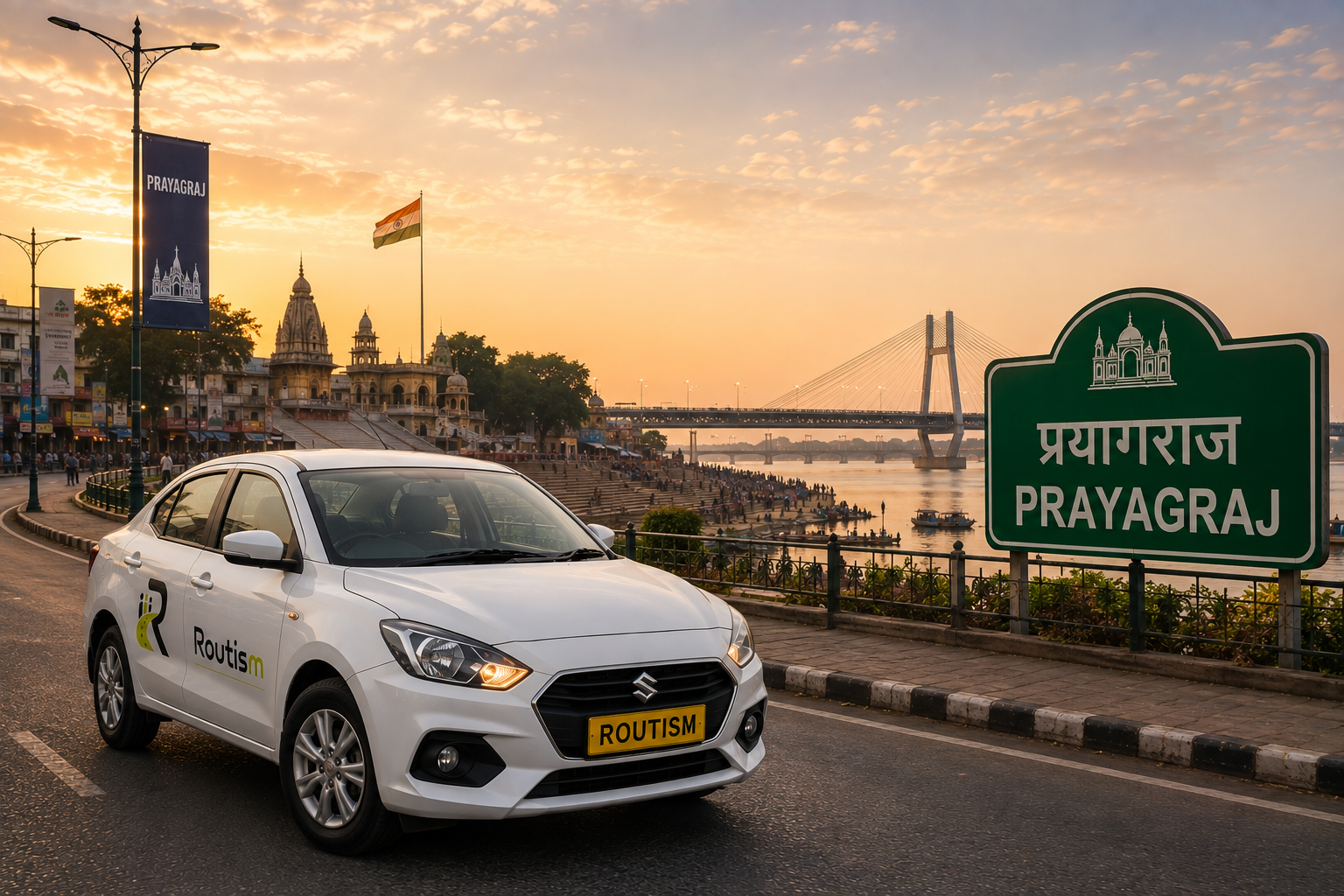
Prayagraj — long known as Allahabad, and one of the most significant pilgrimage, education and administrative centres in Uttar Pradesh — sits at the sacred confluence of the Ganga, Yamuna and the mythical Saraswati at the Triveni Sangam. It's a city that lives two very different lives depending on the calendar: a busy university and administrative town for most of the year, and the site of one of the largest human gatherings on the planet during the Kumbh and Magh Mela seasons, when the 2025 Maha Kumbh alone was expected to draw crowds in the hundreds of millions and briefly multiplied the district's population density roughly tenfold.
Routism is a mobility platform that connects customers with verified drivers to make everyday and long-distance travel safe, secure, affordable and convenient, and Prayagraj — with its unique mix of daily student and administrative commuting, heavy year-round pilgrim traffic to the Sangam, and dramatic seasonal Mela surges — is exactly the kind of city our network is built to serve. As part of our roadmap to cover all of Uttar Pradesh from our headquarters in Lucknow, join the waiting list to get early access the moment Routism opens matching in Prayagraj.
Prayagraj's transport challenge is genuinely unlike any other Uttar Pradesh city on our roadmap, because its baseline population and its peak-event population are worlds apart. Under normal conditions, the Prayagraj district carries a population density of around 1,086 people per square kilometre — notably lower than Varanasi or Kanpur — supporting a comfortable, manageable daily commute pattern built around the city's universities, government offices and local business districts. But during major Mela events, particularly the 2025 Maha Kumbh, that density has been reported to swell by roughly tenfold, turning routine city streets into some of the most congested space anywhere in India, with widely reported gridlock, stampede risk at major bathing days, and supply chains under real strain.
Even in a normal year, Prayagraj hosts the smaller annual Magh Mela at the same Sangam site, drawing millions of pilgrims and seekers who observe the month-long Kalpavas tradition of living by the riverbank. That means Prayagraj never fully switches off from pilgrim travel demand — it simply scales up and down through the year, from a manageable daily flow to an overwhelming seasonal surge. Most of that travel today happens through solo, on-the-spot taxi and auto bookings, exactly the pattern that breaks down hardest when demand spikes fastest.
Routism runs on three core booking systems, each suited to how people actually move through Prayagraj — whether they're pilgrims visiting for the Sangam, students commuting to one of the city's universities, or residents making the same local trip every week.
Book a ride to match your exact need, with competitive fares and rating-based transparency behind every driver.
Shared Booking matches customers travelling on similar Prayagraj routes at similar times. Enter your pickup and drop-off, and Routism identifies compatible co-riders heading the same way — for an airport or station transfer, a Sangam visit, or a long intercity drive to Lucknow or Varanasi. When a match is available, co-riders join the same booking and split the cost between them.
Shared Booking helps to split travel costs, make journeys more affordable, reduce unnecessary empty seats, improve overall vehicle utilisation, potentially reduce the number of vehicles needed on the same route, ease traffic congestion during peak Mela periods, and turn a solo pilgrim or student trip into a more connected, social way of travelling. It supports local, one-way, outstation and round-trip journeys, depending on route compatibility — same direction, same journey, less cost, better utilisation.
Not everyone in Prayagraj is a pilgrim. Daily Commute is built for residents, students, teachers, government staff and professionals who travel the same route at the same time, day after day — a pattern especially relevant in a city with a large university population and a significant administrative workforce. Instead of creating a fresh booking every day, set up a recurring booking for multiple days at once. Routism connects you with suitable drivers and co-commuters on a compatible route and schedule, with route matching, time matching, daily reminders and a predictable, reliable arrangement for everyday travel — a real local commute partner instead of a different arrangement every single week. The recurring booking continues until you or your driver cancels it.
For customers: stop searching for the same ride every day — set your route once and commute with ease. For drivers based in Prayagraj: build regular customers between pilgrim seasons and spend less time searching for new bookings every day.
Prayagraj's core pilgrimage destination, the Triveni Sangam — the confluence of the Ganga, Yamuna and the invisible Saraswati — sits just a few kilometres from the city's main railway stations, close enough for a straightforward Local Ride but far enough, especially during peak footfall, that a verified, pre-arranged trip beats negotiating with an unfamiliar auto driver on arrival. Nearby, Bharadwaj Ashram, believed to be the hermitage that sheltered Lord Rama, Sita and Lakshmana during their exile, and the riverside Maharishi Mahesh Yogi ashram overlooking the Sangam, are among the city's other significant pilgrim stops. Beyond the sacred sites, Prayagraj is also home to the historic University of Allahabad, one of India's oldest, and a cluster of colonial-era administrative buildings reflecting the city's long history as a major seat of government.
Prayagraj's transport network has been built up substantially in recent years to handle its dual role as a university city and a mega-pilgrimage site. Prayagraj Airport (IXD), also known as Bamrauli Airport, sits about 12–13 km from the city centre and runs regular flights to Delhi, Mumbai, Bengaluru, Hyderabad and Kolkata, with pre-paid taxis to the Sangam ghats typically available right at the terminal. The city has eight railway stations in and around it, with Prayagraj Junction (Allahabad Junction) as the main hub, alongside Prayag Station, Rambagh, Naini, Chheoki and Subedarganj providing additional access — all connected to Delhi, Mumbai, Kolkata and Chennai by frequent long-distance trains. On the road, Prayagraj is well served by National Highways NH2, NH19 and NH27, along with regular UPSRTC and private bus services from Lucknow, Kanpur, Delhi and Varanasi.
For travellers arriving at any of these points, especially during high-footfall Mela periods when police-controlled diversions can stretch a normal 20-minute airport transfer to 90–120 minutes, a verified Routism Ride or a cost-split Shared Booking arranged ahead of time is a far more predictable way to complete the journey than an on-the-spot negotiation.
Prayagraj sits at the centre of Uttar Pradesh's spiritual and administrative travel network, and Outstation Rides plus Shared Booking are built directly for it. Prayagraj to Lucknow — roughly 200 km, connected by the Prayagraj Sangam–Lucknow Intercity Express as well as road — carries heavy daily administrative, business and family traffic between the state capital and one of its most significant pilgrimage cities. Prayagraj to Varanasi, about 150 km, and Prayagraj to Ayodhya, link three of North India's most important sacred destinations, drawing travellers who combine multiple sites into a single trip. Prayagraj to Kanpur carries steady business and family travel along one of the state's core highway corridors.
Instead of paying full fare for a solo taxi across any of these routes, a traveller can book an Outstation Ride directly, or join a Shared Booking with another pilgrim, student or traveller already heading the same way — turning one long drive into a shared, more affordable trip for everyone on it. Round-Trip Rides cover the same route out and back in a single booking, ideal for a same-day Lucknow-to-Prayagraj Sangam visit. Read more about the broader Uttar Pradesh intercity network on the Uttar Pradesh state page, and see how the corridor works from the other end on the Lucknow city page.
Prayagraj's travel demand follows one of the most extreme seasonal swings of any city in Uttar Pradesh. The Maha Kumbh Mela, held once every twelve years, is among the largest human gatherings on the planet — the 2025 edition alone was expected to draw crowds in the hundreds of millions over its six-week span, with more than 450 km of additional roads and over 1,850 hectares of parking built specifically to handle the influx, alongside hundreds of special trains added to the rail network. The Magh Mela, held every year at the same Sangam site on a smaller scale, brings a steady annual surge of pilgrims observing the month-long Kalpavas tradition. Major bathing days within these festivals — Mauni Amavasya and Magh Poornima among them — see the single heaviest crowd surges, when even short local trips can take hours longer than usual.
Outside these Mela periods, Prayagraj's daily travel returns to a far more manageable university-and-administrative-city rhythm. This dramatic contrast is exactly why a verified, pre-arranged Routism Ride or Shared Booking matters most here — a fare and a driver agreed upfront, rather than negotiated in the middle of the kind of gridlock Prayagraj's peak Mela days are known for.
Verified drivers. Every driver on Routism goes through a verification process before their profile can accept a booking, which matters even more in a city where visitor volumes can swing from a normal weekday to a Mela-day crowd of millions almost overnight.
Affordable travel. Competitive fares across Rides, plus cost-splitting through Shared Booking, help pilgrims, students and residents alike reduce what they spend on transfers, especially across longer intercity routes like Prayagraj to Lucknow or Varanasi.
Flexible booking. Choose between Local, One-Way, Outstation or Round-Trip Rides, a Shared Booking, or a recurring Daily Commute — whatever the trip actually needs, whether you're visiting for a single Sangam dip or studying and living in the city.
Ratings and trust. Customer and driver ratings build transparency and accountability into every match, giving visitors unfamiliar with Prayagraj a real signal of who they're travelling with.
Better vehicle utilisation. Shared bookings make fuller use of the vehicles already moving through Prayagraj's busiest pilgrim corridors, instead of adding more half-empty cars to an already-strained road network during peak Mela periods.
Recurring connections. Daily Commute lets Prayagraj's students, government staff and daily workers build long-term travel relationships instead of repeatedly searching for a new local booking every single day.
Trust matters most in a city where crowd conditions can change dramatically within days, and where many travellers — students moving to a new city, pilgrims visiting for the first time — don't know local routes or fair fares. Every driver on Routism completes verification before their profile can accept a booking. Fares are transparent and agreed before the trip starts — never haggled over on the roadside, which matters enormously during peak Mela periods when demand-driven price spikes are common. And ratings from both customers and drivers keep the whole Prayagraj travel community accountable over time. Full detail on this process is on the how it works page, and specific questions are answered on the FAQ.
Most travellers in Prayagraj today choose between a few options: negotiate an auto or e-rickshaw fare on the spot, book a private taxi package through a local operator, or rely on Mela-special shuttle buses and UPSRTC services during major festival periods. Each has a real drawback. Negotiating on the spot means paying whatever the moment's demand allows — a particularly acute problem on the six major bathing days of a Kumbh year. A private taxi package usually means paying full fare alone, even when other travellers on your train or flight are headed to the exact same Sangam ghats. And Mela shuttles, while affordable, run on fixed routes and schedules that don't always match your specific pickup point or timing.
Routism sits in between: close to the door-to-door convenience of a private taxi, at a fraction of the cost when a Shared Booking match is available, with driver verification and a rating system that neither a roadside negotiation nor an unfamiliar local operator can reliably offer — valuable both in Prayagraj's calm off-season months and during its most crowded Mela weeks.
The process is short, whether you're a pilgrim in town for a single darshan or a student commuting locally:
For now, the first step is the waiting list — it's how early access, founding member status and route priority get decided as Prayagraj's matching network comes online.
No places have been published for this city yet.
Common questions about Smart, Safe & Affordable Mobility in Prayagraj — Routism.
Is Routism available in Prayagraj yet? Prayagraj is part of Routism's Uttar Pradesh expansion roadmap, following our launch in Lucknow. Join the waiting list for early access as matching opens in the city.
Can Routism help with airport or railway station transfers in Prayagraj? Yes — One-Way and Local Rides are built exactly for transfers from Prayagraj Airport (Bamrauli), Prayagraj Junction or the city's other stations to your hotel or straight to the Sangam.
Can I book a shared ride from Lucknow to Prayagraj? Yes — Outstation Rides and Shared Booking both cover the Prayagraj–Lucknow corridor, along with routes to Varanasi, Ayodhya and Kanpur. See the Lucknow city page and the Uttar Pradesh state page for more on these corridors.
Is Routism useful outside Kumbh and Magh Mela season? Yes — Daily Commute is built for Prayagraj's students, government staff and daily workers who need reliable local travel year-round, not just during the city's major pilgrimage events.
How does Routism keep rides safe during crowded Mela periods in Prayagraj? Every driver completes a verification process before a booking is offered, fares are transparent and agreed upfront rather than negotiated on arrival, and a customer-and-driver rating system keeps the community accountable — especially valuable when demand-driven price spikes and crowd disruption are at their worst. Details are on the how it works and FAQ pages.
Can I book a round trip for a same-day Sangam visit? Yes — Round-Trip Rides cover the onward and return journey together in a single booking, ideal for a same-day visit from Lucknow, Varanasi or nearby cities.
Routism — safe journeys, smart connections, better mobility. Starting from Lucknow. Available across Uttar Pradesh.
Join the waiting list with your name, mobile number, email and route to get early access the moment Routism opens in Prayagraj. Explore the broader network on the Uttar Pradesh state page, see how the Prayagraj–Lucknow corridor works from our headquarters city on the Lucknow page, or read how Routism works.
End of Prayagraj city page content.