
Varanasi, Uttar Pradesh's spiritual capital, is next on Routism's expansion map after Lucknow. Verified carpooling and ride sharing for BHU students, Cantt and Sigra office commuters, ghat-bound pilgrims and travellers heading to Prayagraj, Ayodhya or Gorakhpur — built for a city where narrow lanes and temple-corridor traffic make solo driving painfully slow.
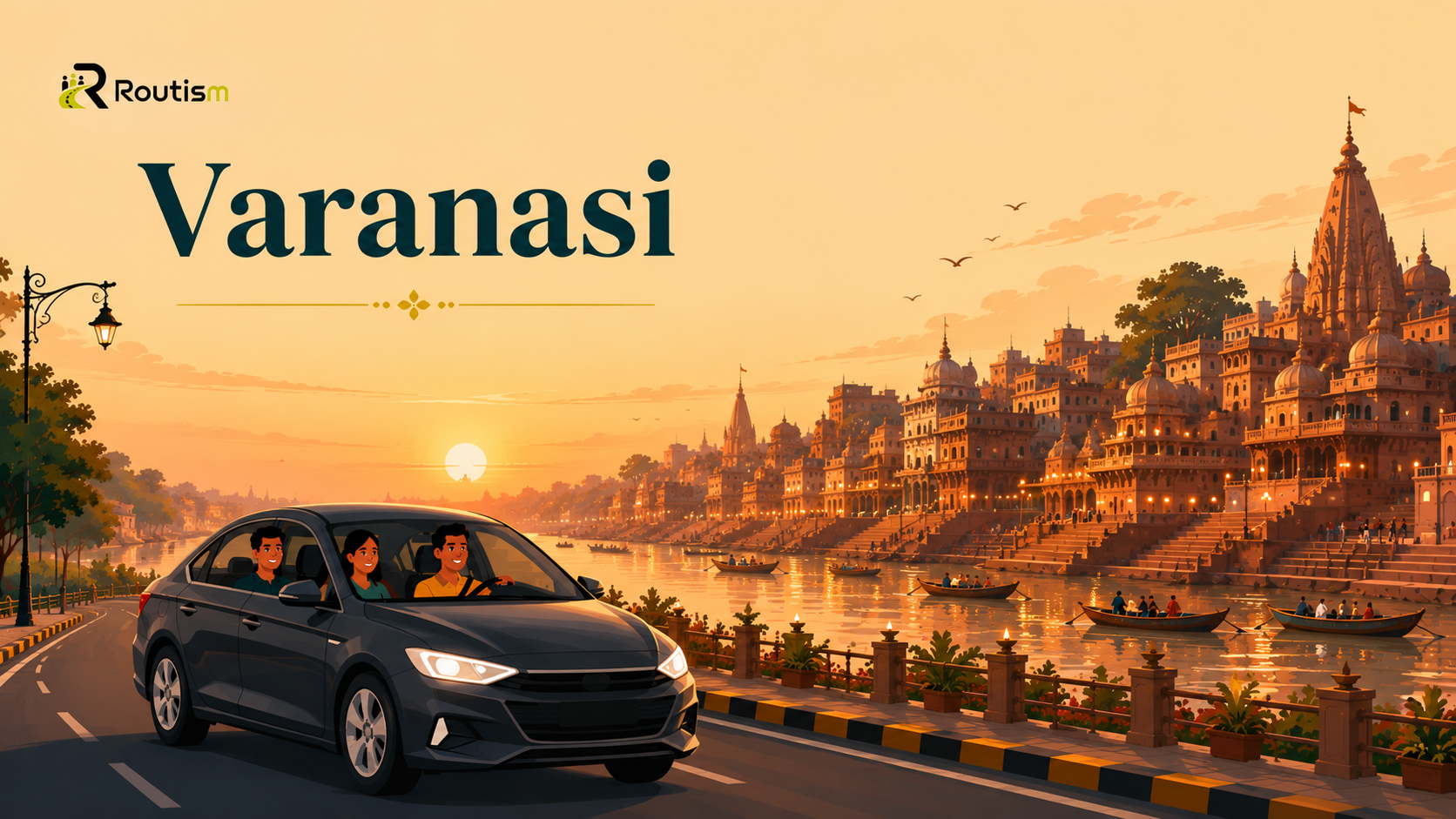
Varanasi — Kashi, Banaras, "India's eternal city" — is one of the oldest continuously inhabited cities on earth, and also one of the most congested. A metropolitan region built for tongas and pedestrians now carries lakhs of daily pilgrims, students, government employees and a fast-growing IT and services workforce, and it does this on a road network of narrow lanes, single-carriageway ghat roads and a handful of choke-point intersections. Since Routism began in Lucknow, Uttar Pradesh's capital and the company's headquarters city, Varanasi has been one of the most requested cities on our waiting list — and for good reason. Between the Kashi Vishwanath Temple corridor traffic, the daily grind between residential Varanasi and the Banaras Hindu University campus, and long intercity runs to Prayagraj, Ayodhya and Gorakhpur, Varanasi is exactly the kind of city Routism is designed for: thousands of people driving nearly identical routes, alone, every single day.
Routism is a verified ride-sharing and carpooling platform, and Varanasi is planned as one of the first cities we expand to from our Lucknow HQ, as part of our wider rollout across Uttar Pradesh. This page exists so Varanasi residents, students and commuters can join the waiting list early, tell us their routes, and help decide which corridor — Sigra to BHU, Cantt to Lanka, or an intercity Share Ride to Prayagraj — we switch on first.
Varanasi's traffic problem is not like Lucknow's or Kanpur's. It is shaped by three things at once: a historic old-city core that was never built for motor vehicles, a religious tourism economy that keeps growing every year, and a modern city of students, offices and government departments layered on top of it. A few things make ride sharing and carpooling a genuinely useful fit here, rather than just another app trying to find traction:
Just like on the Uttar Pradesh state page, Routism's answer to this is the same three ride systems that already work in Lucknow: one-off Rides, cost-splitting Shared Booking, and recurring Daily Commute — read the full breakdown on how it works.
Varanasi is unusual among Uttar Pradesh's major cities because its transport problem is not simply "too many cars." It is a layered problem: a medieval street grid in the old city that physically cannot be widened, a river that splits east-bank and west-bank travel around a limited number of crossings, and a visitor economy that adds hundreds of thousands of extra trips on festival days, weekends and the wedding and pilgrimage season, on top of the daily movement of residents, students and office-goers. A resident commuting from Mahmoorganj to a Cantt office, or a student travelling from Sigra to BHU, is often stuck behind the exact same congestion caused by pilgrim traffic headed to the ghats — even though their trip has nothing to do with tourism at all. Ride sharing does not fix road width, but it does reduce the number of vehicles making that trip in the first place, which is the one lever an app can actually pull. Fewer solo cars and unmetered rickshaws chasing the same route means less competition for the same limited road space, and a more predictable commute for everyone who has to make that trip five or six days a week.
The economics matter as much as the traffic. A private car or taxi making a Varanasi-to-Prayagraj run, or a daily Sigra-to-BHU trip, usually carries one paying passenger and burns fuel and tolls for the whole vehicle regardless of how many seats are empty. Shared Booking exists specifically to close that gap: a customer already heading in the same direction fills the empty seat, the driver earns more per trip without extending the route, and both sides split a cost that would otherwise be paid in full by one person. Over a month of daily BHU or Cantt-Sigra commuting, or a handful of Prayagraj and Ayodhya trips, that difference compounds into real savings — the same principle described in more detail on the Uttar Pradesh state page and the how it works page.
Banaras Hindu University students and staff. BHU's Lanka-side campus draws students and faculty from across the city and beyond. A Daily Commute booking — one fixed route, one fixed time, recurring every weekday — replaces the daily scramble to find a shared auto or negotiate a rickshaw fare from Sigra, Mahmoorganj, Sundarpur or Nadesar toward the university.
Office and government employees. Varanasi's administrative and business activity clusters around Cantonment, Sigra, Nadesar and the Collectorate-Kachahri belt. Employees commuting daily from residential areas like Mahmoorganj, Bhelupur, Lanka or Sundarpur toward these office zones are exactly the recurring-route pattern Daily Commute is designed for.
Pilgrims and tourists. Varanasi is a destination city first. Visitors flying into Lal Bahadur Shastri International Airport at Babatpur, or arriving by train at Varanasi Junction (Cantt) or Banaras (Manduadih) station, need a reliable, fairly priced, verified way to reach the old city, the ghats or a hotel near Kashi Vishwanath Temple — a shared Ride or a Shared Booking can cut that cost meaningfully for families and groups.
Purvanchal intercity travellers. Varanasi is a hub, not an endpoint, for a large part of eastern Uttar Pradesh. People regularly travelling to Prayagraj, Ayodhya, Jaunpur, Mirzapur, Ghazipur or Gorakhpur for work, study or family reasons are ideal candidates for Shared Booking on intercity Share Rides, splitting fuel and toll costs on a trip they were going to make anyway.
Women commuters looking for a safer alternative. As on every Routism city page, driver identity, licence and vehicle verification plus a two-sided rating system are designed to make solo travel — for a student heading back from a late class, or a professional finishing a night shift near Cantt — noticeably safer than getting into an unverified vehicle.
When Varanasi goes live, Routism content and route-matching will span the city's major landmarks, ghats and commuter localities — mirroring the locality-level detail already published for Lucknow and its places. Planned coverage includes:
(Each locality above is planned as its own /places/[slug] page, following the exact structure already live for Lucknow's Gomti Nagar, Hazratganj and Aliganj pages — short description, common routes, and a link back to this city page.)
Based on how Lucknow's early corridors were prioritised (Gomti Nagar ↔ Hazratganj, Indira Nagar ↔ Vibhuti Khand, Lucknow ↔ Kanpur), the Varanasi routes most likely to open first are:
Every one of these is a placeholder based on demand signals, not a fixed launch order — the waiting list is what actually decides which Varanasi corridor Routism switches on first, exactly as described on the Uttar Pradesh state page.
Two corridors deserve a special mention because of how much repetitive daily traffic they carry. The Sigra–BHU–Lanka belt is arguably Varanasi's single busiest recurring-commute corridor: thousands of students, teaching staff and university employees make close to the same trip, at close to the same time, every weekday of the academic year, which is exactly the pattern Daily Commute was built to absorb. The Varanasi–Prayagraj corridor, meanwhile, is one of the most heavily travelled intercity routes in the Purvanchal region — connecting two of Uttar Pradesh's biggest pilgrimage and education hubs — and regularly sees solo drivers and near-empty taxis making a trip that a Shared Booking could easily split three or four ways.
Every driver on Routism — in Varanasi, in Lucknow, or anywhere else in Uttar Pradesh — completes identity, licence and vehicle verification before being able to offer a Ride, a Shared Booking seat, or a Daily Commute route. Contact details between a customer and a driver unlock only once both sides confirm a booking, and every completed trip feeds into a two-way rating system, so both drivers and customers build a visible trust record over time. This matters even more in a city like Varanasi, where a large share of visitors are unfamiliar with local transport, travelling with family, or arriving late at night from the airport or railway station. The same trust model is explained in full on the FAQ and how it works pages.
Common questions about Varanasi Ride Sharing: Verified Carpool Partners, Daily Commute & Shared Booking.
Is Routism live in Varanasi yet? Not yet. Routism has launched first from its Lucknow headquarters as part of a phased rollout across Uttar Pradesh. Varanasi is one of the next planned cities, and this page exists so people in Varanasi can join the waiting list before launch.
How do I get early access to carpooling in Varanasi? Join the Routism waiting list and share your usual route — for example, Sigra to BHU, Cantt to Godowlia, or Varanasi to Prayagraj. Demand signals like this directly shape which Varanasi corridor is activated first.
Will Routism cover BHU student commutes? Yes — Banaras Hindu University and the surrounding Lanka locality are planned as one of the highest-priority Daily Commute corridors in Varanasi, alongside the Sigra and Cantt office belt.
Does Routism plan to offer airport and railway station transfers in Varanasi? Shared transfers to and from Lal Bahadur Shastri International Airport at Babatpur, and Varanasi's Cantt and Manduadih railway stations, are part of the planned local Ride and Shared Booking coverage for the city.
Can I use Routism for intercity trips out of Varanasi? Yes. Once live, Varanasi will support intercity Share Rides to nearby cities such as Prayagraj, Ayodhya, Jaunpur, Mirzapur, Ghazipur and Gorakhpur, using the same route-matching and shared-fare model already used for Lucknow's intercity corridors.
How does Routism keep carpooling safe in a pilgrimage city like Varanasi? Every driver completes identity, licence and vehicle verification, contact details stay private until a booking is confirmed, and every trip contributes to a two-sided rating system — the same trust model used across all of Routism's Uttar Pradesh cities. Full detail is on the FAQ page.
Is Routism only for local trips inside Varanasi, or also for longer journeys? Both. Inside the city, Routism covers local Rides and recurring Daily Commute routes such as Sigra to BHU or Mahmoorganj to Cantt. Beyond the city, it covers intercity Share Rides on routes like Varanasi to Prayagraj, Ayodhya or Gorakhpur, so a single platform handles both the daily commute and the longer Purvanchal journeys residents already make regularly.
How is Routism different from an unmetered auto or e-rickshaw in Varanasi? With Routism, the fare is shown before the trip begins instead of being negotiated on the spot, the driver has already completed identity and vehicle verification, and both driver and customer carry a rating history from previous trips — a level of transparency that ad-hoc local transport in Varanasi's old city typically does not offer.
Routism — safe journeys, smart connections, better mobility. Starting from Lucknow. Available across Uttar Pradesh.
Join the waiting list with your name, mobile number, email and route to get early access the moment Routism opens in Varanasi. Explore the broader network on the Uttar Pradesh state page, see how the Lucknow–Varanasi corridor works from our headquarters city on the Lucknow page, or read how Routism works.
End of Varanasi city page content.