
Visit Lucknow's famous Bara Imambara and Bhul Bhulaiya with verified Rides, Shared Booking and Round-Trip transfers across the city — all via Routism.
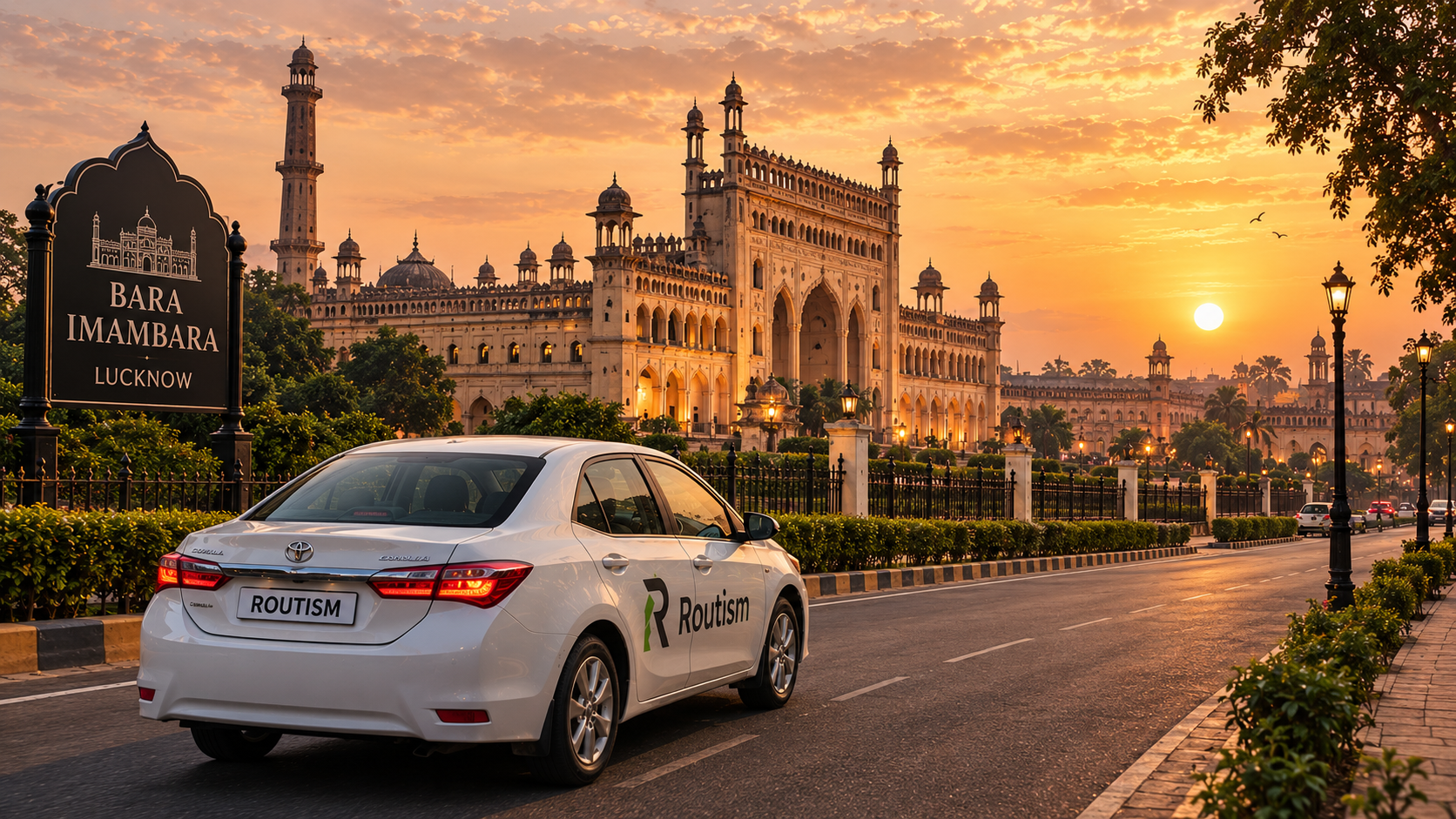
Bara Imambara, also known as Asfi Imambara, is Lucknow's grandest surviving Nawabi monument and one of the most-visited heritage sites in Uttar Pradesh — a vast 18th-century complex famous above all for the Bhul Bhulaiya, the labyrinth of narrow interconnected passages built into the thickness of its upper walls. Nearly every visitor to old Lucknow makes their way here, alongside the neighbouring Chota Imambara, Rumi Darwaza and the Husainabad monument cluster, and nearly all of that travel today happens through solo cab bookings or a fresh auto negotiation at the gate, one traveller paying full fare for a trip that others heading to the exact same old-city circuit are very likely making too.
Routism is a mobility platform that connects customers with verified drivers to make everyday and long-distance travel safe, secure, affordable and convenient, and a Bara Imambara visit — with its predictable heritage-circuit traffic, its position in old Lucknow's dense, narrow-laned core, and its role as the anchor of a wider monument tour — is exactly the kind of journey our network is built to serve. Join the waiting list to get early access the moment Routism opens matching for Bara Imambara and the rest of Lucknow.
A Bara Imambara trip has a shape most journeys don't: it's almost never a single stop. Visitors typically combine it with Chota Imambara, the Husainabad Picture Gallery and Shahi Hamam nearby, plus Rumi Darwaza just a short distance away — a natural half-day circuit through old Lucknow's most historic quarter, near Machchhi Bhavan. That circuit runs through some of the city's narrowest, most congested lanes, where parking is scarce and where a hired guide is genuinely recommended for navigating the Bhul Bhulaiya safely — all reasons a pre-arranged, reliable ride beats arriving without a plan and negotiating transport between each stop.
The monument's own popularity compounds this. Bara Imambara draws heavy year-round tourist footfall, plus a very different kind of crowd each year during Muharram, when the complex functions as a working Shia congregation hall rather than a sightseeing stop, filling with mourners observing the religious significance of the site. Both patterns — steady tourist traffic and sharp religious-calendar peaks — reward the same thing: a verified ride booked ahead, rather than a scramble for transport once you're already there.
Routism runs on three core booking systems, each suited to a different part of a Bara Imambara visit.
Book a ride to match your exact need, with competitive fares and rating-based transparency behind every driver.
Shared Booking matches customers travelling to or from Bara Imambara on similar routes at similar times. Enter your pickup and drop-off, and Routism identifies compatible co-riders heading the same way — for a station transfer, a heritage-circuit day out, or a longer intercity drive for visitors arriving from elsewhere in Uttar Pradesh. When a match is available, co-riders join the same booking and split the cost between them.
Shared Booking helps to split travel costs, make journeys more affordable, reduce unnecessary empty seats, improve overall vehicle utilisation, potentially reduce the number of vehicles needed on the same route, ease traffic congestion around old Lucknow's narrow monument-circuit lanes, and turn a solo sightseeing trip into a more connected, social way of travelling. It supports local, one-way, outstation and round-trip journeys, depending on route compatibility — same direction, same journey, less cost, better utilisation.
Bara Imambara isn't only a tourist stop — the surrounding old-city quarter is home to residents, shopkeepers, guides and Husainabad Trust staff who travel the same route into the area at the same time, day after day. Daily Commute is built exactly for that pattern. Instead of creating a fresh booking every day, set up a recurring booking for multiple days at once. Routism connects you with suitable drivers and co-commuters on a compatible route and schedule, with route matching, time matching, daily reminders and a predictable, reliable arrangement for everyday travel. The recurring booking continues until you or your driver cancels it.
For customers: stop searching for the same ride every day — set your route once and commute with ease. For drivers based near old Lucknow: build regular customers and spend less time searching for new bookings every day.
Construction on Bara Imambara began in 1784 under Nawab Asaf-ud-Daula, the fourth Nawab of Awadh, and took roughly seven years to complete. The project is remembered as much for its purpose as its architecture: Awadh was suffering a catastrophic famine at the time, and the Nawab commissioned the building partly as a large-scale relief effort, employing thousands of unemployed people during a period of genuine hardship — a story that adds real emotional weight to a visit alongside its architectural grandeur. The complex is built almost entirely in Lakhauri brick faced with stucco, using traditional lime mortar mixed with ingredients including urad dal and jaggery, and is famous for its central hall, one of the largest vaulted galleries of its kind built without any supporting pillars or beams — an engineering achievement that has stood for well over two centuries.
Above that hall runs the Bhul Bhulaiya, the maze that gives Bara Imambara much of its fame — a lattice of narrow interconnected passages and stairwells built directly into the structural thickness of the walls, with a popular claim of 1,024 ways in and only two ways out. Hiring a guide is strongly recommended for navigating it safely and for reaching the rooftop, which opens onto sweeping views across old Lucknow. The wider complex also includes the three-domed Asfi Mosque and the Bowli, a step-well with running water. The site is open daily except Mondays, generally from around 6:00 AM to 5:00 or 6:00 PM, with entry priced at roughly ₹25–50 for Indian visitors and ₹500 for foreign visitors — a combined ticket that also covers Chota Imambara, the Husainabad Picture Gallery and the Shahi Hamam, making a single half-day trip genuinely worthwhile.
Bara Imambara sits roughly 4 km from Lucknow Junction railway station and about 15 km from Chaudhary Charan Singh International Airport, both easy Local or One-Way Ride distances. From Hazratganj, Lucknow's central shopping district, and from residential hubs like Gomti Nagar and Indira Nagar, the old-city monument circuit is a well-travelled cross-town trip for both tourists and locals combining a heritage visit with the rest of their day. See the Hazratganj place page for more on that corridor, and the full Lucknow city page for the wider network of localities Routism is mapping across the city.
For travellers arriving at any of these points, a verified Routism Ride or a cost-split Shared Booking is a more predictable way to reach Bara Imambara — and to move on to the next stop on the old-city circuit — than negotiating a fresh auto fare at every gate, particularly in lanes where parking is genuinely limited.
Bara Imambara's crowd patterns follow two very different rhythms. Year-round, the monument draws steady tourist and heritage-tour traffic, generally busiest in the cooler months from October to March when walking the old-city lanes is most comfortable. Muharram, observed each year according to the Islamic lunar calendar, transforms the complex into a working religious site, filling with mourners rather than sightseers as the Shia community observes the occasion's deep significance at what remains a functioning congregation hall. Both patterns bring genuine crowding to the surrounding lanes and courtyard, and both reward a pre-arranged ride over an on-the-spot search for transport.
A pre-agreed Routism Ride or Shared Booking, arranged before you arrive rather than negotiated in a crowded old-city lane, is a far more predictable way to reach Bara Imambara when it matters most — whether that's a packed weekend tourist crowd or the religious significance of Muharram.
Few of Lucknow's landmarks carry a founding story as genuinely moving as Bara Imambara's. When Nawab Asaf-ud-Daula began construction in 1784, Awadh was in the grip of a catastrophic famine, and thousands of people across the region had no work and no way to feed their families. Rather than simply distributing relief, the Nawab commissioned a building project on a monumental scale specifically so that ordinary people could earn a wage with dignity — reportedly employing labourers by day and, according to popular local accounts, having nobles and elites quietly demolish sections of unfinished wall by night so the work, and the pay that came with it, could continue for as long as the famine lasted. Whether every detail of that story is literal history or partly legend, it has become inseparable from how Lucknow tells the story of the building, and it's part of why so many guides open a Bara Imambara tour with the famine before they even mention the architecture.
The architecture itself remains a genuine engineering mystery even today. The central hall's pillarless, beamless vaulted ceiling — among the largest of its kind anywhere — was built entirely with the masonry knowledge available in 18th-century Awadh, using interlocking brickwork and a lime-based mortar rather than any modern structural support, and it has held for well over two centuries with only routine conservation. Architects and engineers still study the hall as an unusually sophisticated example of pre-modern vaulted construction, and the Bhul Bhulaiya above it, built directly into the thickness of the load-bearing walls rather than as a separate structure, is as much a feat of structural design as it is a maze meant to disorient.
Verified drivers. Every driver on Routism goes through a verification process before their profile can accept a booking, which matters even more in old Lucknow's dense, narrow-laned monument quarter, where first-time visitors are especially unfamiliar with the layout.
Affordable travel. Competitive fares across Rides, plus cost-splitting through Shared Booking, help tourists and residents alike reduce what they spend on transfers around the old-city heritage circuit.
Flexible booking. Choose between Local, One-Way, Outstation or Round-Trip Rides, a Shared Booking, or a recurring Daily Commute — whatever the trip actually needs, whether you're visiting for a single half-day tour or living and working near the monument.
Ratings and trust. Customer and driver ratings build transparency and accountability into every match, giving first-time visitors a real signal of who they're travelling with.
Better vehicle utilisation. Shared bookings make fuller use of the vehicles already moving through old Lucknow's monument circuit, instead of adding more half-empty cars to an already-narrow, already-congested set of lanes.
Recurring connections. Daily Commute lets old-city residents, shopkeepers and Husainabad Trust staff build long-term travel relationships instead of repeatedly searching for a new local booking every single day.
Trust matters most in a heritage quarter where the majority of visitors are unfamiliar with local routes, fair fares and trustworthy drivers. Every driver on Routism completes verification before their profile can accept a booking. Fares are transparent and agreed before the trip starts — never haggled over on the roadside, which is especially valuable in old Lucknow's dense lanes where price negotiation with unfamiliar drivers is a common visitor frustration. And ratings from both customers and drivers keep the whole Bara Imambara travel community accountable over time. Full detail on this process is on the how it works page, and specific questions are answered on the FAQ.
Most visitors today choose between a few options: negotiate an auto-rickshaw fare stop by stop through the old-city monument circuit, book a private taxi package through a local operator or hotel, or hire a cycle-rickshaw for short hops within the narrowest lanes. Each has a real drawback. Stop-by-stop negotiation means paying whatever the moment's demand allows at every single monument gate. A private taxi package usually means paying alone, even when other travellers on your train or at your hotel are heading to the exact same heritage circuit. And while cycle-rickshaws suit the narrowest old-city lanes well, they offer no verification and no fixed fare for anything beyond a short local hop.
Routism sits in between: close to the door-to-door convenience of a private taxi, at a fraction of the cost when a Shared Booking match is available, with driver verification and a rating system that neither roadside negotiation nor an unfamiliar local operator can reliably offer.
The process is short, whether you're a first-time visitor or planning a full heritage-circuit day:
For now, the first step is the waiting list — it's how early access, founding member status and route priority get decided as Lucknow's matching network comes online.