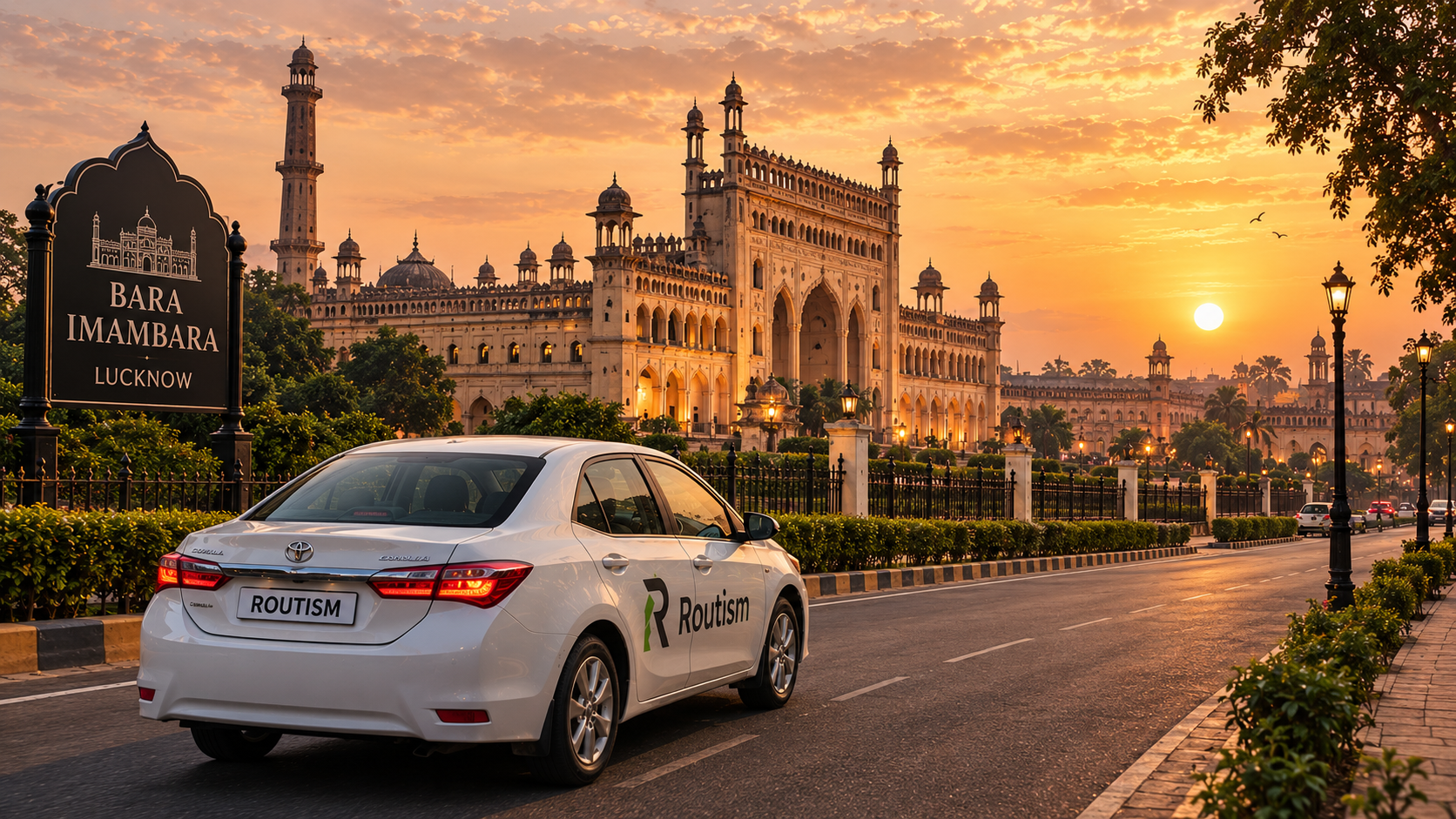
Visit Lucknow's dazzling Chota Imambara, the "Palace of Lights," with verified Rides, Shared Booking and Round-Trip transfers — all through Routism.
Chota Imambara, also known as Hussainabad Imambara, sits about 2 km west of its larger counterpart Bara Imambara in Lucknow's Hussainabad heritage zone — and despite its name meaning "Small Imambara," most visitors come away calling it the more visually stunning of the two. Built in 1838 as a mausoleum for Nawab Muhammad Ali Shah and his mother, and known to European visitors of the era as the "Palace of Lights" for its dazzling chandeliers and gilt mirrors, Chota Imambara draws a steady stream of heritage tourists, architecture enthusiasts and photographers every day, most of whom fold it into a wider old-city circuit that includes Bara Imambara, Rumi Darwaza and the nearby Hussainabad Clock Tower. Nearly everyone currently arrives through a solo cab booking or an on-the-spot auto negotiation, one traveller paying full fare for a trip that others heading to the exact same heritage cluster are very likely making too.
Routism is a mobility platform that connects customers with verified drivers to make everyday and long-distance travel safe, secure, affordable and convenient, and a Chota Imambara visit — with its position deep in old Lucknow's Hussainabad quarter, its predictable heritage-circuit traffic, and its natural pairing with Bara Imambara and Rumi Darwaza — is exactly the kind of journey our network is built to serve. Join the waiting list to get early access the moment Routism opens matching for Chota Imambara and the rest of Lucknow.
Chota Imambara is almost never visited alone — its location just 2 km from Bara Imambara, inside the same Hussainabad heritage zone that also holds the Husainabad Clock Tower, the Satkhanda watchtower and Rumi Darwaza, makes it the natural second or third stop on a half-day old-Lucknow monument circuit. That kind of multi-stop itinerary is exactly where a pre-arranged, reliable ride matters most: reaching each site with enough time to actually appreciate the interiors — chandeliers, calligraphy and mirror work that reward slow, unhurried viewing — rather than negotiating a fresh auto fare at every gate and rushing between stops.
The monument's own visiting hours add another layer worth planning around. Timings differ from source to source and can shift by day of the week, with some accounts noting shorter Friday hours around prayer time — exactly the kind of detail worth confirming locally before you set out, and exactly the kind of trip where a driver who knows the old city's rhythm, rather than an unfamiliar one hailed at the roadside, makes the day go more smoothly.
Routism runs on three core booking systems, each suited to a different part of a Chota Imambara visit.
Book a ride to match your exact need, with competitive fares and rating-based transparency behind every driver.
Shared Booking matches customers travelling to or from Chota Imambara on similar routes at similar times. Enter your pickup and drop-off, and Routism identifies compatible co-riders heading the same way — for a station transfer, a heritage-circuit day out, or a longer intercity drive for visitors arriving from elsewhere in Uttar Pradesh. When a match is available, co-riders join the same booking and split the cost between them.
Shared Booking helps to split travel costs, make journeys more affordable, reduce unnecessary empty seats, improve overall vehicle utilisation, potentially reduce the number of vehicles needed on the same route, ease traffic congestion around the Hussainabad heritage zone, and turn a solo sightseeing trip into a more connected, social way of travelling. It supports local, one-way, outstation and round-trip journeys, depending on route compatibility — same direction, same journey, less cost, better utilisation.
Chota Imambara isn't only a tourist stop — the surrounding Hussainabad quarter is home to residents, shopkeepers, guides and trust staff who travel the same route into the area at the same time, day after day. Daily Commute is built exactly for that pattern. Instead of creating a fresh booking every day, set up a recurring booking for multiple days at once. Routism connects you with suitable drivers and co-commuters on a compatible route and schedule, with route matching, time matching, daily reminders and a predictable, reliable arrangement for everyday travel. The recurring booking continues until you or your driver cancels it.
For customers: stop searching for the same ride every day — set your route once and commute with ease. For drivers based near old Lucknow: build regular customers and spend less time searching for new bookings every day.
Chota Imambara was built in 1838 by Nawab Muhammad Ali Shah, the third Nawab of Awadh, as a mausoleum for himself and his mother, Princess Kummu Sultana — and, much like Bara Imambara before it, the project also functioned as a famine relief effort, providing paid employment to local people during a genuinely difficult period for the region. Despite the "Chota" (small) in its name, the monument is widely considered architecturally more elaborate than its larger namesake, blending Charbagh garden design with Indo-Islamic and Persian influences beneath a striking golden dome, with Quranic verses rendered in intricate calligraphy across the exterior walls.
The real spectacle, though, is inside. The interior is famous for its ornate gold-leaf work, colourful stucco decoration and an extraordinary collection of Belgian crystal chandeliers imported by the Nawab himself — decorations so lavish that European visitors of the era began calling the building the "Palace of Lights," a nickname that has stuck ever since, especially given how spectacular the chandeliers look when fully illuminated during festivals like Muharram. The wider complex includes the tombs of the Nawab's daughter and her husband, popularly described as miniature echoes of the Taj Mahal, along with the ceremonial Husainabad Gateway, a large water tank, a mosque, and the nearby Satkhanda, a seven-storey watchtower that was left permanently unfinished. The Hussainabad Clock Tower, one of the tallest clock towers in India, stands close by and is often visited in the same trip. Reported visiting hours vary by source — some list a straightforward 6:00 AM to 5:00 PM or 8:00 AM to 6:00 PM daily window, while others describe longer 7:00 AM to 7:00 PM hours from Thursday to Saturday and a shorter 2:00 PM to 6:00 PM window on Fridays — so it's worth confirming locally on the day. Entry fees are similarly modest for Indian visitors, around ₹25, with a higher fee for foreign tourists.
Chota Imambara sits roughly 7 km from Lucknow Junction railway station and about 2 km west of Bara Imambara, both easy Local or One-Way Ride distances within the same old-city visit. The nearest metro station, Pandeyganj, is about 2 km away. From Hazratganj, Lucknow's central shopping district, and from residential hubs like Gomti Nagar and Indira Nagar, the Hussainabad heritage zone is a well-travelled cross-town trip for both tourists and locals combining a heritage visit with the rest of their day. See the Bara Imambara place page and the Hazratganj place page for more on these nearby corridors, and the full Lucknow city page for the wider network of localities Routism is mapping across the city.
For travellers arriving at any of these points, a verified Routism Ride or a cost-split Shared Booking is a more predictable way to reach Chota Imambara — and to move on to the next stop on the old-city circuit — than negotiating a fresh auto fare at every gate.
Chota Imambara's crowd patterns follow two distinct rhythms. Year-round, the monument draws steady heritage-tourism traffic, with many guides recommending the summer months from May through August for the best overall experience, alongside the more comfortable cooler months from October to March. Muharram, observed each year according to the Islamic lunar calendar, transforms the "Palace of Lights" into its most spectacular self — the chandeliers and decorative lighting the monument is named for are at their most elaborate during this period, drawing both religious observers and photographers eager to see the building fully illuminated.
Both patterns bring genuine crowding to the Hussainabad quarter's lanes and courtyards, and both reward a pre-arranged ride over an on-the-spot search for transport. A pre-agreed Routism Ride or Shared Booking, arranged before you arrive, is a far more predictable way to reach Chota Imambara when it matters most.
There's a small irony built into Chota Imambara's very name — "small" beside Bara Imambara's "big" — because visitors who've seen both consistently rate this one as the more impressive of the two, at least on the inside. Where Bara Imambara's fame rests on structural engineering — that vast, pillarless central hall — Chota Imambara's reputation was built almost entirely on decoration: Belgian crystal chandeliers personally imported by Nawab Muhammad Ali Shah, walls layered in gold leaf and colourful stucco work, and calligraphy so precisely rendered that European visitors of the 19th century simply started calling the building something more evocative than its official name. "Palace of Lights" wasn't a title the Nawab gave it — it was a nickname that grew organically out of how the building actually made people feel standing inside it, lit by hundreds of imported crystal fixtures in a Lucknow that had never seen anything quite like it before.
That same instinct for spectacle carried through the rest of the complex: the miniature Taj-Mahal-style tombs built for the Nawab's daughter and her son-in-law, the grand ceremonial sweep of the Husainabad Gateway, and the deliberately mysterious Satkhanda watchtower, left permanently unfinished at just four of its planned seven storeys after Muhammad Ali Shah's death interrupted construction — a genuine architectural cliffhanger that still draws curious questions from visitors nearly two centuries later. Seen together with Bara Imambara just two kilometres away, the two monuments form a kind of before-and-after portrait of Awadhi Nawabi taste — one built for engineering awe, the other for pure visual splendour — which is exactly why heritage guides so consistently recommend seeing them on the same day rather than choosing between them.
Verified drivers. Every driver on Routism goes through a verification process before their profile can accept a booking, which matters even more in old Lucknow's Hussainabad quarter, where first-time visitors are especially unfamiliar with the layout.
Affordable travel. Competitive fares across Rides, plus cost-splitting through Shared Booking, help tourists and residents alike reduce what they spend on transfers around the old-city heritage circuit.
Flexible booking. Choose between Local, One-Way, Outstation or Round-Trip Rides, a Shared Booking, or a recurring Daily Commute — whatever the trip actually needs, whether you're visiting for a single half-day tour or living and working near the monument.
Ratings and trust. Customer and driver ratings build transparency and accountability into every match, giving first-time visitors a real signal of who they're travelling with.
Better vehicle utilisation. Shared bookings make fuller use of the vehicles already moving through the Hussainabad heritage zone, instead of adding more half-empty cars to an already-narrow set of old-city lanes.
Recurring connections. Daily Commute lets Hussainabad residents, shopkeepers and trust staff build long-term travel relationships instead of repeatedly searching for a new local booking every single day.
Trust matters most in a heritage quarter where the majority of visitors are unfamiliar with local routes, fair fares and trustworthy drivers. Every driver on Routism completes verification before their profile can accept a booking. Fares are transparent and agreed before the trip starts — never haggled over on the roadside, which is especially valuable in old Lucknow's dense lanes where price negotiation with unfamiliar drivers is a common visitor frustration. And ratings from both customers and drivers keep the whole Chota Imambara travel community accountable over time. Full detail on this process is on the how it works page, and specific questions are answered on the FAQ.
Most visitors today choose between a few options: negotiate an auto-rickshaw fare stop by stop through the old-city monument circuit, book a private taxi package through a local operator or hotel, or hire a cycle-rickshaw for short hops within the narrowest lanes. Each has a real drawback. Stop-by-stop negotiation means paying whatever the moment's demand allows at every single monument gate. A private taxi package usually means paying alone, even when other travellers on your train or at your hotel are heading to the exact same heritage circuit. And while cycle-rickshaws suit the narrowest old-city lanes well, they offer no verification and no fixed fare for anything beyond a short local hop.
Routism sits in between: close to the door-to-door convenience of a private taxi, at a fraction of the cost when a Shared Booking match is available, with driver verification and a rating system that neither roadside negotiation nor an unfamiliar local operator can reliably offer.
The process is short, whether you're a first-time visitor or planning a full heritage-circuit day:
For now, the first step is the waiting list — it's how early access, founding member status and route priority get decided as Lucknow's matching network comes online.
Common questions about Chota Imambara, Lucknow — Verified Rides, Shared Booking & Daily Commute with Routism.
Is Routism available for Chota Imambara trips yet? Chota Imambara is part of Routism's launch coverage for Lucknow, our headquarters city. Join the waiting list for early access as matching opens.
Can Routism help me get to Chota Imambara from Hazratganj or Gomti Nagar? Yes — Local Rides and Round-Trip Rides both cover this cross-town trip into old Lucknow's Hussainabad quarter. See the Hazratganj place page and the Lucknow city page for more.
Can I book a round trip covering Chota Imambara, Bara Imambara and Rumi Darwaza together? Yes — Round-Trip Rides cover the onward and return journey together in a single booking, ideal for a full half-day tour of old Lucknow's monument circuit.
Is there a Routism option for Hussainabad's residents and shopkeepers? Yes — Daily Commute matches you with riders and drivers whose route and days genuinely overlap, ideal for anyone living or working near the monument quarter.
How does Routism keep rides to Chota Imambara safe? Every driver completes a verification process before a booking is offered, fares are transparent and agreed upfront rather than negotiated stop by stop, and a customer-and-driver rating system keeps the community accountable. Details are on the how it works and FAQ pages.
What are Chota Imambara's visiting hours? Reported hours vary by source, with some listing a daily 6:00 AM–5:00 PM or 8:00 AM–6:00 PM window and others describing longer hours from Thursday to Saturday and a shorter Friday window — always worth confirming locally on the day.
Routism — safe journeys, smart connections, better mobility. Starting from Lucknow. Available across Uttar Pradesh.
Join the waiting list with your name, mobile number, email and route to get early access the moment Routism opens matching for Chota Imambara and the rest of Lucknow. Explore the full Lucknow city page, pair your visit with the Bara Imambara place page, or read how Routism works.
End of Chota Imambara place page content.