Verified Rides, Shared Booking and Daily Commute in Ayodhya — pilgrim transfers, local travel and intercity trips to Lucknow, Varanasi & Prayagraj on Routism.
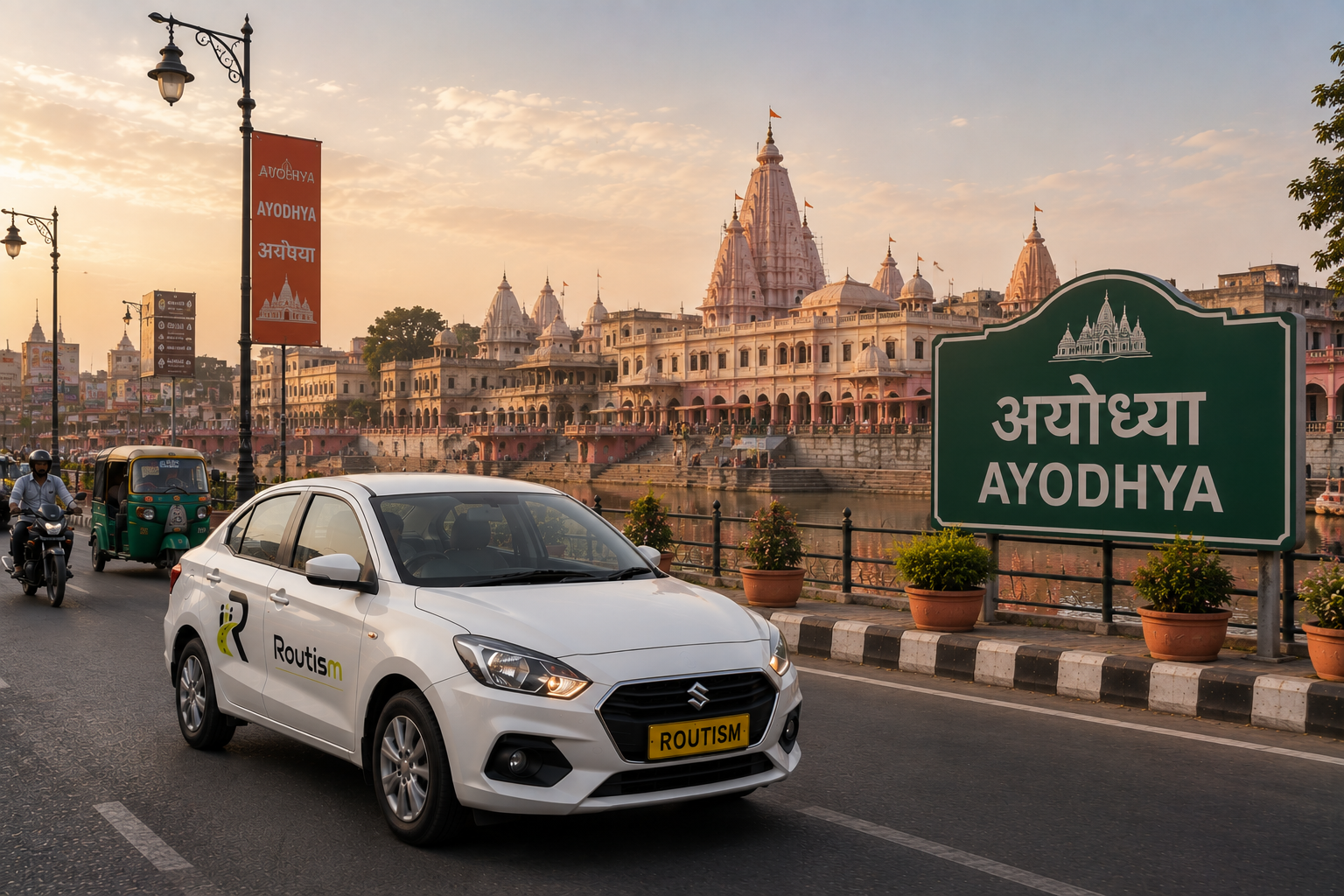
Ayodhya, one of India's most sacred pilgrimage cities and a district of Uttar Pradesh, has gone through one of the most dramatic tourism transformations anywhere in the country in the last few years. Footfall has surged, with the Uttar Pradesh government reporting nearly 23 crore visitors to Ayodhya between January and June 2025 alone, and independent tourism analysis pointing to more than 164 million annual visitors by 2024 — a rise of over 2,600% since 2020. Every one of those visitors needs to get from a railway station, an airport, a bus stand or a hotel to the Ram Janmabhoomi complex, the Saryu ghats, Hanumangarhi and back again, and most of them are doing it in a solo cab or a rented car with empty seats beside them.
Routism is a mobility platform that connects customers with verified drivers to make everyday and long-distance travel safe, secure, affordable and convenient — and Ayodhya, with its unique mix of daily pilgrim transfers, local travel and heavy intercity connection to Lucknow, Varanasi and Prayagraj, is exactly the kind of city our network is built for. As part of our roadmap to serve customers and drivers across all of Uttar Pradesh, join the waiting list to get early access the moment Routism opens matching in Ayodhya.
Ayodhya's transport infrastructure has expanded fast — a new international airport, a rebuilt railway junction, a wide pilgrim boulevard connecting the station to the temple — but the sheer scale of visitor growth has outpaced even that expansion. With visitor numbers climbing into the hundreds of millions annually, the city now deals with genuine peak-season congestion on the routes leading in from Lucknow, Gorakhpur, Varanasi and Prayagraj, and within the city itself around the Ram Path corridor, Hanumangarhi and the Saryu riverfront, especially during Ram Navami, Diwali and other major festival periods.
Most of that travel today happens one solo booking at a time: a family flies into Maharishi Valmiki International Airport and books a private taxi alone, a pilgrim arrives at Ayodhya Dham Junction and negotiates a fresh auto fare on the spot, a devotee travels from Lucknow and pays full fare for an entire cab rather than splitting it with other travellers on the same route. Multiplied across the crore-scale visitor numbers Ayodhya now sees every year, that's an enormous amount of duplicated, unshared travel on roads that were never built to carry it alone.
Routism runs on three core booking systems, each suited to how people actually move through Ayodhya — whether they're pilgrims in the city for a single day or residents making the same local trip every week.
Book a ride to match your exact need, with competitive fares and rating-based transparency behind every driver.
Shared Booking matches customers travelling on similar Ayodhya routes at similar times. Enter your pickup and drop-off, and Routism identifies compatible co-riders heading the same way — for an airport transfer, a station pickup, or a long intercity drive to Lucknow or Varanasi. When a match is available, co-riders join the same booking and split the cost between them.
Shared Booking helps to split travel costs, make journeys more affordable, reduce unnecessary empty seats, improve overall vehicle utilisation, potentially reduce the number of vehicles needed on the same route, ease traffic congestion during peak pilgrimage season, and turn a solo pilgrim transfer into a more connected, social way of travelling. It supports local, one-way, outstation and round-trip journeys, depending on route compatibility — same direction, same journey, less cost, better utilisation.
Not everyone in Ayodhya is a visitor. Daily Commute is built for residents, shopkeepers, temple staff, students and professionals who travel the same route at the same time, day after day. Instead of creating a fresh booking every day, set up a recurring booking for multiple days at once. Routism connects you with suitable drivers and co-commuters on a compatible route and schedule, with route matching, time matching, daily reminders and a predictable, reliable arrangement for everyday travel — a real local commute partner instead of a different arrangement every single week. The recurring booking continues until you or your driver cancels it.
For customers: stop searching for the same ride every day — set your route once and commute with ease. For drivers based in Ayodhya: build regular customers between pilgrim seasons and spend less time searching for new bookings every day.
Ayodhya's key pilgrim landmarks are spread across a compact but often heavily crowded core, and Local and One-Way Rides on Routism are built to cover exactly this pattern.
The Ram Janmabhoomi temple complex on Ramkot Hill is the city's central destination, reached from Ayodhya Dham Junction via Ram Path, the wide, stone-paved pilgrim boulevard built specifically to handle the post-consecration surge in footfall since January 2024. Hanumangarhi, one of Ayodhya's most-visited temples dedicated to Hanuman, sits close to the main temple circuit and draws heavy daily crowds of its own. The Saryu riverfront and ghats, where pilgrims perform aarti and take a ritual dip, form another major daily-visit destination, particularly at dawn and dusk. Beyond the immediate temple core, visitors extending their stay often explore Ayodhya's other heritage sites and museums documenting the region's history — all reachable with a straightforward Local Ride instead of negotiating a fresh auto fare at every stop.
Ayodhya's transport hub network has grown rapidly alongside its visitor numbers, and every entry point into the city is a natural Routism pickup point.
Maharishi Valmiki International Airport (AYJ) is the city's main air gateway, roughly 10–12 km from the Ram Mandir — a 25–30 minute drive that's ideal for a One-Way or Local Ride straight to your hotel or the temple area. Ayodhya Dham Junction, the nearest railway station to the temple at just 1.2–2 km away, handles the bulk of pilgrim rail traffic, while Ayodhya Cantt (formerly Faizabad Junction), about 8–10 km out, connects the city to Delhi, Lucknow, Varanasi and Prayagraj via regular and Vande Bharat Express services. The Ayodhya Dham Bus Station, run by UPSRTC, links the city to Lucknow, Agra, Gorakhpur, Prayagraj and other major Uttar Pradesh cities with frequent, budget-friendly services.
For travellers arriving at any of these points — especially during high-footfall periods when auto-rickshaw and app-cab availability gets inconsistent — a verified Routism Ride or a cost-split Shared Booking is a more predictable way to complete the final leg to your accommodation or straight to the temple.
Ayodhya sits at the centre of one of Uttar Pradesh's busiest pilgrim-and-tourism travel circuits, and Outstation Rides plus Shared Booking are built directly for it. Ayodhya to Lucknow — roughly 140 km, about a 3-hour drive — is one of the most-travelled corridors in the state, carrying pilgrims, families and business travellers in both directions daily. Ayodhya to Varanasi and Ayodhya to Prayagraj link three of North India's most significant spiritual destinations, drawing travellers who combine multiple sacred sites into a single trip. Ayodhya to Gorakhpur carries a similar mix of pilgrim and regional travel, while Ayodhya to Delhi, a longer haul of around 630 km, sees steady long-distance pilgrim and family traffic, often broken up via Lucknow.
Instead of paying full fare for a solo taxi across any of these routes, a traveller can book an Outstation Ride directly, or join a Shared Booking with another pilgrim or traveller already heading the same way — turning one long drive into a shared, more affordable trip for everyone on it. Round-Trip Rides cover the same route out and back in a single booking, ideal for a same-day Lucknow-to-Ayodhya darshan trip. Read more about the broader Uttar Pradesh intercity network on the Uttar Pradesh state page, and see how the corridor works from the other end on the Lucknow city page.
Ayodhya's travel demand is highly seasonal in a way few other Uttar Pradesh cities are. Ram Navami in March or April is the single biggest crowd event in the city's calendar, drawing enormous pilgrim volumes over a concentrated few days. Diwali, marked with large-scale illumination events across the city, and the winter pleasant-weather months from October through March, both bring sustained high footfall for temple visits and sightseeing. Even outside these peaks, weekends see noticeably heavier crowds than weekdays on Ram Path and around the main temple complex.
These are exactly the periods when informal, un-pre-arranged travel breaks down — auto rates climb, cab availability gets inconsistent, and a solo booking costs the most. A pre-agreed Routism Ride or Shared Booking, arranged before you arrive rather than negotiated on the spot during peak season, is a far more predictable way to move through the city when it matters most.
Verified drivers. Every driver on Routism goes through a verification process before their profile can accept a booking, which matters even more in a pilgrim city where travellers are often unfamiliar with local routes, fares and landmarks.
Affordable travel. Competitive fares across Rides, plus cost-splitting through Shared Booking, help pilgrims and residents alike reduce what they spend on transfers, especially across longer intercity routes like Ayodhya to Lucknow or Varanasi.
Flexible booking. Choose between Local, One-Way, Outstation or Round-Trip Rides, a Shared Booking, or a recurring Daily Commute — whatever the trip actually needs, whether you're visiting for a single darshan or living and working in the city.
Ratings and trust. Customer and driver ratings build transparency and accountability into every match, giving visitors unfamiliar with Ayodhya a real signal of who they're travelling with.
Better vehicle utilisation. Shared bookings make fuller use of the vehicles already moving through Ayodhya's busiest pilgrim corridors, instead of adding more half-empty cars to an already-congested Ram Path and airport road.
Recurring connections. Daily Commute lets Ayodhya's residents, shopkeepers and daily workers build long-term travel relationships instead of repeatedly searching for a new local booking every single day.
Trust matters most in a city where the majority of travellers are visiting for the first time and don't know local routes, fair fares or trustworthy drivers. Every driver on Routism completes verification before their profile can accept a booking. Fares are transparent and agreed before the trip starts — never haggled over on the roadside, which is especially valuable during high-footfall festival periods when negotiated auto and cab rates tend to climb. And ratings from both customers and drivers keep the whole Ayodhya travel community accountable over time. Full detail on this process is on the how it works page, and specific questions are answered on the FAQ.
Every shared seat matters more in Ayodhya than in most cities, simply because of scale. With visitor numbers now running into the hundreds of millions annually, even a modest shift from solo bookings to Shared Booking translates into a meaningful reduction in the number of vehicles competing for space on Ram Path, the airport road and the approaches from Lucknow and Gorakhpur during peak season. Fewer solo trips also means lower fuel consumption and emissions per traveller across the city's busiest pilgrim corridors — a real consideration for a city investing heavily in sustainable, long-term tourism infrastructure. On the economic side, pilgrims spend less per transfer because the cost is split, and local drivers turn otherwise-idle time between bookings into steadier, more predictable income, especially valuable in the slower months between major festivals.
Most travellers in Ayodhya today choose between a few options: negotiate an auto or e-rickshaw fare on the spot, book a private taxi package through a local operator, or rely on UPSRTC buses for intercity travel. Each has a real drawback. Negotiating on the spot means paying whatever the moment's demand allows, especially during festival season. A private taxi package usually means paying full fare alone, even when other travellers on your flight or train are headed the exact same way. And buses, while budget-friendly, mean fixed schedules and limited last-mile connectivity from the bus stand to your specific hotel or temple gate.
Routism sits in between: close to the door-to-door convenience and comfort of a private taxi, at a fraction of the cost when a Shared Booking match is available, with driver verification and a rating system that neither a roadside negotiation nor an unfamiliar local operator can reliably offer.
The process is short, whether you're a pilgrim arriving for a single day or a resident commuting locally:
For now, the first step is the waiting list — it's how early access, founding member status and route priority get decided as Ayodhya's matching network comes online.
Common questions about Smart, Safe & Affordable Mobility in Ayodhya — Routism.
Is Routism available in Ayodhya yet? Ayodhya is part of Routism's Uttar Pradesh expansion roadmap, following our launch in Lucknow. Join the waiting list for early access as matching opens in the city.
Can Routism help with airport or railway station transfers in Ayodhya? Yes — One-Way and Local Rides are built exactly for transfers from Maharishi Valmiki International Airport, Ayodhya Dham Junction or Ayodhya Cantt to your hotel or the temple area.
Can I book a shared ride from Lucknow to Ayodhya? Yes — Outstation Rides and Shared Booking both cover the Lucknow–Ayodhya corridor, along with routes to Varanasi, Prayagraj and Gorakhpur. See the Lucknow city page and the Uttar Pradesh state page for more on these corridors.
Is Routism useful outside pilgrimage season? Yes — Daily Commute is built for Ayodhya residents and daily workers who need reliable local travel year-round, not just during festival peaks.
How does Routism keep rides safe for pilgrims unfamiliar with Ayodhya? Every driver completes a verification process before a booking is offered, fares are transparent and agreed upfront rather than negotiated on arrival, and a customer-and-driver rating system keeps the community accountable. Details are on the how it works and FAQ pages.
Can I book a round trip for a same-day Ayodhya darshan visit? Yes — Round-Trip Rides cover the onward and return journey together in a single booking, ideal for a same-day visit from Lucknow, Gorakhpur or nearby cities.
Routism — safe journeys, smart connections, better mobility. Starting from Lucknow. Available across Uttar Pradesh.
Join the waiting list with your name, mobile number, email and route to get early access the moment Routism opens in Ayodhya. Explore the broader network on the Uttar Pradesh state page, see how the Lucknow–Ayodhya corridor works from our headquarters city on the Lucknow page, or read how Routism works.
End of Ayodhya city page content.