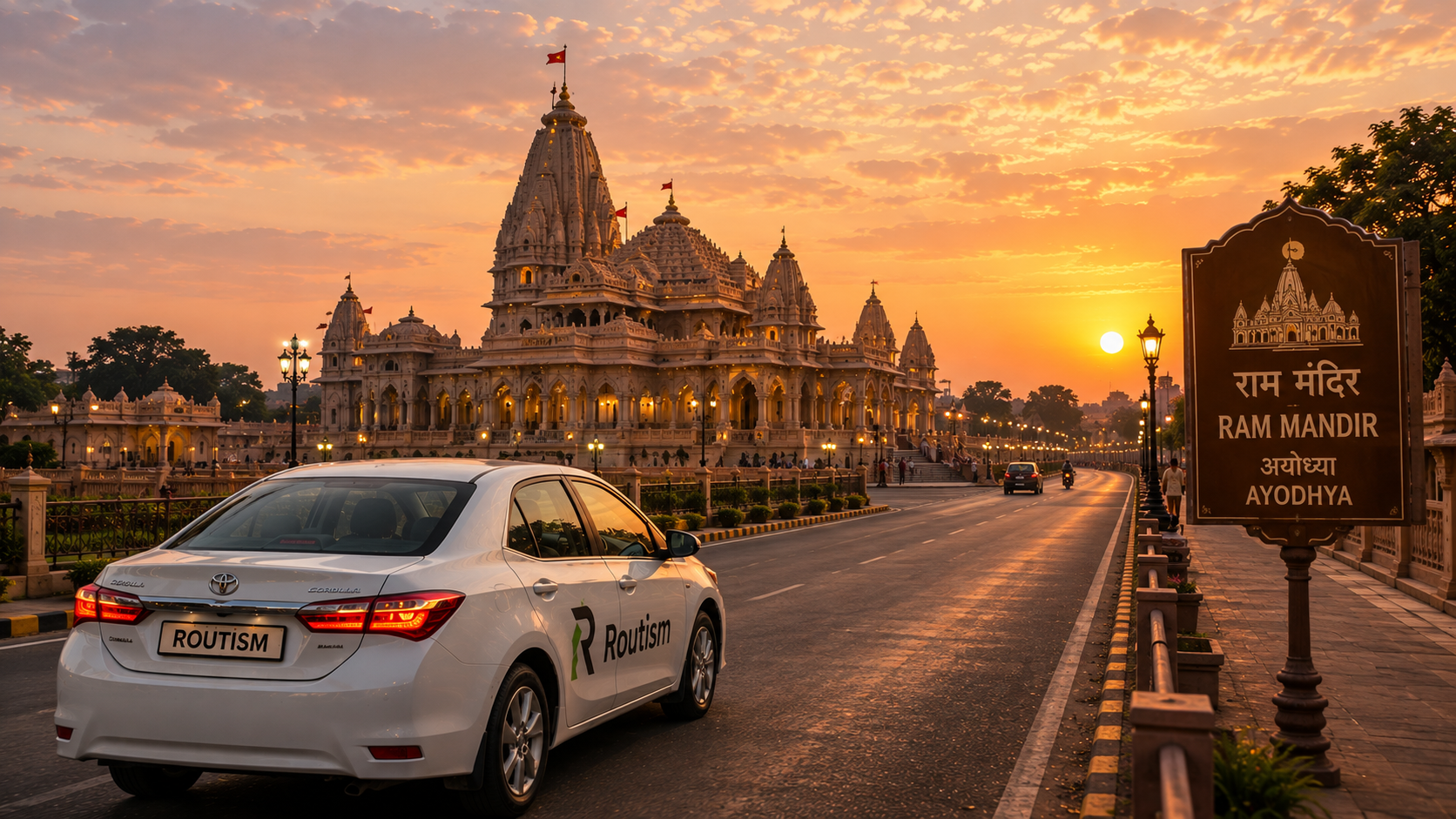
Book a verified Routism ride to Dashrath Bhavan, Ayodhya — the ancient palace site of King Dashrath. Local, shared & outstation pilgrimage travel. From Lucknow.
Dashrath Bhavan, also known as Dashrath Mahal, Badi Jagah or Bada Asthan, is believed to stand on the site of the original royal palace of King Dashrath, father of Lord Ram, in the heart of Ayodhya's Ramkot area. This is where Ram, Lakshman, Bharat and Shatrughna are believed to have spent their childhood, and where one of the Ramayana's most pivotal moments — Ram's exile — was set in motion. Today the site is a vibrant palace-temple complex housing shrines of Ram, Lakshman and Sita, with saffron-clad monks chanting and singing inside its decorated, ornamented entrance. For millions of pilgrims visiting Ayodhya each year, it holds a very specific place in the pilgrimage circuit: many begin their day here, at the household of the Raghu dynasty, before continuing on to Hanuman Garhi and the Ram Mandir itself. Routism is a mobility platform built to connect verified drivers with riders for exactly this kind of layered pilgrimage journey.
Our approach is simple — connect people, simplify journeys, and make every darshan easier to reach. We are starting our journey from Lucknow and building Routism to serve customers and drivers across Uttar Pradesh's biggest pilgrimage destinations, Ayodhya and Dashrath Bhavan among them. Join the waiting list to get early access the moment we open Ayodhya routes.
Ayodhya's pilgrim footfall has grown dramatically since the Ram Mandir's consecration, and every one of those visitors is arriving from somewhere else — Lucknow is roughly 135 km away, Varanasi around 190 km, and pilgrims travel in from across India and beyond, landing at Ayodhya's airport, Ayodhya Dham railway station, or arriving by road. Dashrath Bhavan itself sits centrally in Ramkot, only about 500 metres from Ram Janmabhoomi and roughly 50 metres from Hanuman Garhi, and roughly 2 km from Ayodhya Junction railway station — genuinely walkable once you're in the old city, but the first leg, from a station, airport or hotel into Ramkot's dense pilgrim lanes, is where most visitors need a reliable ride the most.
Local priests and guides in Ayodhya follow a well-established sequence: Dashrath Bhavan first, to seek the blessings of King Dashrath and Queen Kaushalya, then Hanuman Garhi, then the Ram Mandir — a route that makes the most of the temple's 8:00 AM opening, roughly half an hour before the first big wave of Ram Mandir pilgrims arrives. Getting to Ramkot on time for that opening, especially from an outstation arrival point, is exactly the kind of trip a verified, pre-booked ride solves cleanly.
Routism is built around three core booking systems, each suited to a different kind of Ayodhya journey.
Customers can book a ride to match their exact travel need, with fair, transparent, competitive fares and rating-based trust behind every driver.
Shared Booking is a natural fit for Ayodhya, where large numbers of pilgrims arrive from the same outstation cities and follow the same well-known temple sequence. A customer enters their pickup and drop-off locations, and Routism identifies compatible co-riders travelling the same way. When a suitable match is available, co-riders join the same booking and split the cost between them.
Shared Booking helps to:
Shared Booking can support local, one-way, outstation and round-trip journeys, depending on route compatibility — same circuit, same journey, less cost, better utilisation.
Daily Commute is designed for people who travel the same route at the same time, day after day — priests, temple staff, local guides, and residents of Ramkot and surrounding localities who make this same journey as part of a daily routine.
Instead of creating a fresh booking every day, customers can set up a recurring booking for multiple days at once. Routism connects them with suitable drivers and co-commuters travelling on a compatible route and schedule, and the recurring arrangement continues until either side cancels it, in line with the applicable booking terms.
Daily Commute provides:
For customers: stop arranging transport into Ramkot every single day — set your route once and commute with ease. For drivers: build regular customers around one of Uttar Pradesh's fastest-growing pilgrimage corridors.
Dashrath Bhavan is almost always visited as the first stop in a well-worn Ayodhya sequence, not a standalone trip. Routism makes it easy to plan the full morning using flexible Rides or a cost-saving Shared Booking with co-travellers heading the same way — Hanuman Garhi, just 50 metres away, the Ram Mandir at Ram Janmabhoomi, roughly 500 metres from the gate, and further out, Kanak Bhawan and the Sarayu river ghats. See the full Ayodhya places guide for the rest of the pilgrimage circuit.
Ayodhya sits at the centre of Uttar Pradesh's busiest and fastest-growing pilgrim corridor, and it's one of the priority destinations on our expansion roadmap alongside Lucknow. Dashrath Bhavan is roughly 2 km from Ayodhya Junction railway station and sits in the dense, pilgrim-heavy lanes of Ramkot, where a pre-arranged ride matters far more than in a wide-open city street. Outstation corridors from Lucknow, Varanasi and Prayagraj into Ayodhya carry heavy year-round pilgrim traffic, spiking further during Ram Navami, Diwali, Karthik Mela and Shravan Mela — exactly the pattern Outstation Rides and Shared Booking are built for.
Our long-term objective is a mobility ecosystem where a pilgrim can use Routism regardless of which Uttar Pradesh city they're travelling from — Lucknow, Varanasi, Prayagraj or elsewhere — to reach Dashrath Bhavan and the rest of Ayodhya's temple circuit. Every signup on the waiting list is what moves that roadmap forward.
Verified drivers. Every driver on Routism goes through a verification process before their profile can accept a booking, so pilgrims connect with people who have actually been checked, not an unmarked vehicle picked up outside a crowded railway station.
Affordable travel. Competitive fares across Rides, and cost-splitting through Shared Booking, help pilgrims reduce what they spend on travel — without giving up convenience, even during Ram Navami or Karthik Mela rush.
Flexible booking. Choose between individual rides (local, one-way, outstation or round-trip), shared journeys, or a recurring Daily Commute — whatever the pilgrimage actually needs.
Ratings and trust. Customer and driver ratings build transparency and accountability into every journey, so decisions about who to travel with are based on real signals, not guesswork in an unfamiliar city.
Built around the pilgrimage sequence. Book your ride timed for the 8:00 AM opening, so you can follow the traditional Dashrath Bhavan-to-Hanuman Garhi-to-Ram Mandir route ahead of the busiest crowds.
Better vehicle utilisation. Shared bookings make fuller use of the seats already heading into Ramkot from the same outstation cities, instead of adding more half-empty vehicles to Ayodhya's rapidly growing pilgrim traffic.
Getting into a vehicle with a stranger only works if trust is real, not assumed — and it matters even more in a pilgrim city where footfall has surged sharply in recent years. Every driver on Routism completes verification before a ride is ever offered, fares are agreed transparently before the trip starts, and ratings from both customers and drivers keep the entire community accountable. You can read the full mechanics on the how it works page, or check specific questions on the FAQ. For solo women travellers and families arriving in Ayodhya for the first time, that sequencing isn't a bonus feature — it's the default flow for every ride to Dashrath Bhavan.
Right now, most pilgrims reaching Dashrath Bhavan choose between three options: drive themselves into Ramkot's narrow, crowded lanes with no local knowledge of where to park, flag down a local taxi or auto outside Ayodhya Junction with no fixed, pre-agreed fare, or rely on a shared jeep with no verification and no accountability during peak festival crowds. Driving yourself means navigating unfamiliar pilgrim lanes without guidance. An unmetered local taxi means negotiating a price on the spot, often at a premium during festival season. A shared local vehicle is cheap but comes with no driver verification and no rating history behind it.
Routism sits in between: close to the door-to-door convenience of a private vehicle, at a fraction of the cost of travelling alone, with verified drivers and rating-based trust that neither an unmarked taxi nor an informal shared jeep can reliably offer.
The process is the same short flow whether you're coming from Lucknow, Varanasi, Prayagraj or within Ayodhya:
The only step before any of that, for now, is the waiting list — the fastest way to get early access and help decide when we open Ayodhya routes.
Whichever group you fall into, the starting point is the same: join the Routism waiting list, tell us your route, and get early access — plus founding member status — the moment we open in Ayodhya.
Common questions about Dashrath Bhavan, Ayodhya — Verified Rides to Where the Ramayana Begins — Routism.
Is Routism available in Ayodhya yet? Not yet. We're starting from Lucknow and expanding to further Uttar Pradesh pilgrimage destinations, including Ayodhya, as demand from the waiting list builds.
What are Dashrath Bhavan's darshan timings? The temple is generally open daily from 8:00 AM to 12:00 PM and again from 4:00 PM to around 9:00–10:00 PM, and entry is free.
How far is Dashrath Bhavan from Ayodhya Junction railway station? Roughly 2 km, well within Ramkot, the dense pilgrim quarter at the heart of Ayodhya.
Can I visit Dashrath Bhavan along with Hanuman Garhi and the Ram Mandir in one trip? Yes — the three sites sit close together, with Hanuman Garhi around 50 metres away and Ram Janmabhoomi roughly 500 metres from the gate, making them a natural single-morning circuit that Rides and Shared Booking can support once we're live in Ayodhya.
Is travelling to Ayodhya safe for solo women pilgrims? Driver verification and a rating-based trust system are built into every booking type, from a single Local Ride to a recurring Daily Commute. Full details are on the how it works and FAQ pages.
Can I set up a recurring ride if I visit Dashrath Bhavan every day? Yes. Daily Commute is built specifically for repeat daily journeys — set your route and travel days once, and Routism matches you with compatible drivers or co-commuters without you needing to rebook every day.
How do I get early access when Routism launches in Ayodhya? Join the waiting list with your name, mobile number and the route you travel. Waiting-list members get early access, founding member status, and a direct say in which routes open first.
Routism — safe journeys, smart connections, better mobility. Starting from Lucknow. Reaching Dashrath Bhavan and every corner of Uttar Pradesh's pilgrim circuit.
Start with the Lucknow city page for locality-level routes, browse the places we already cover, read how Routism works, learn more about us, or head straight to the waiting list to lock in early access for your Ayodhya route.
End of Dashrath Bhavan place page content.