Plan your Ram Mandir darshan with verified Rides, Shared Booking and Round-Trip transfers from Lucknow, Ayodhya and beyond — all through Routism.
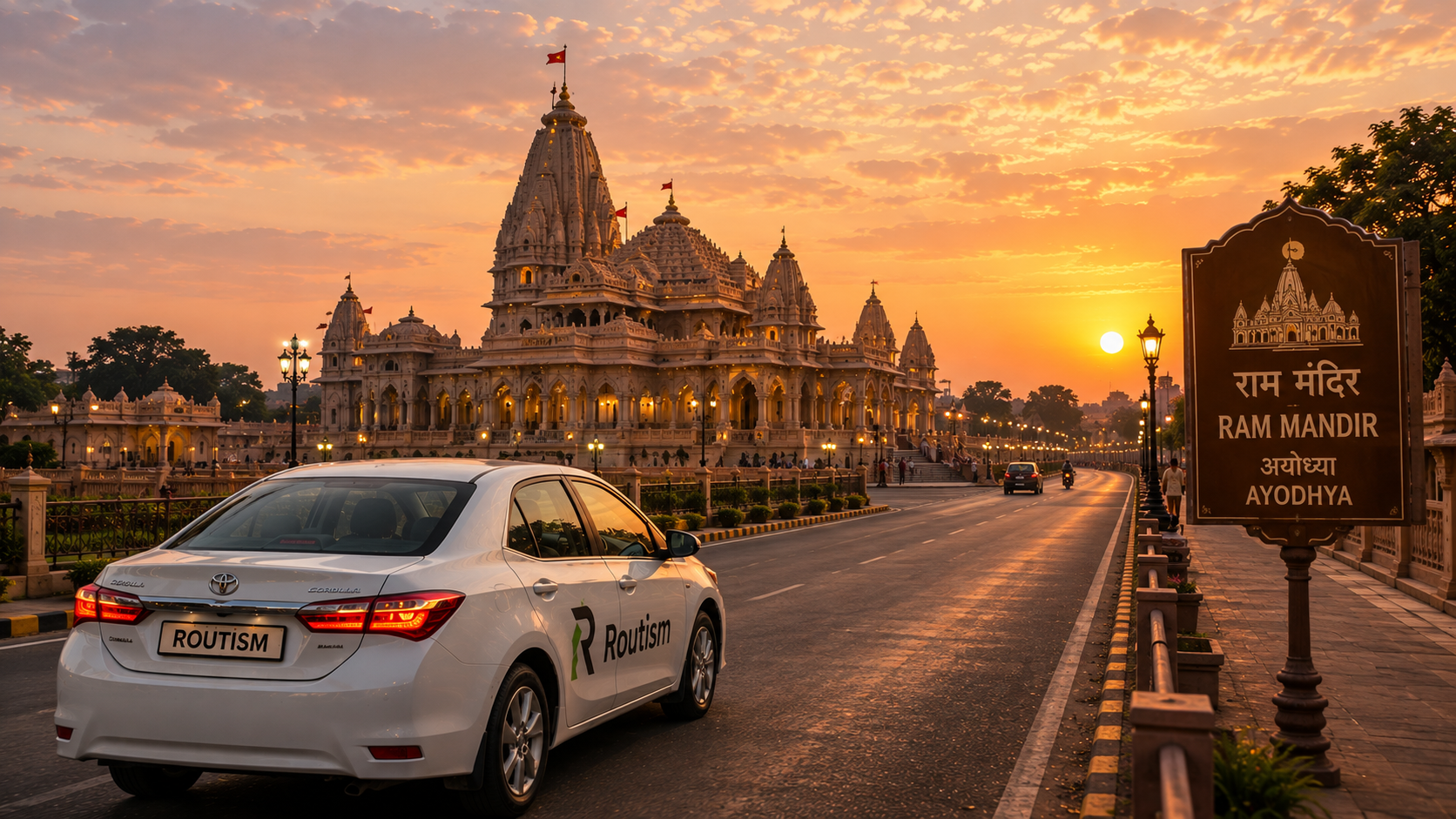
The Shri Ram Janmabhoomi Temple in Ayodhya — built on the site traditionally identified as Lord Ram's birthplace — has become, since its consecration in January 2024, India's single most-visited spiritual destination, with well over 135 million domestic and international visitors recorded in the time since. Every one of those visitors needs a ride from a railway station, an airport, a hotel or a neighbouring city to reach the temple, then a way back — and today, most of that travel happens through solo bookings arranged on arrival, one traveller paying full fare for a car that has three empty seats beside them.
Routism is a mobility platform that connects customers with verified drivers to make everyday and long-distance travel safe, secure, affordable and convenient, and a Ram Mandir darshan trip — with its predictable pilgrim traffic patterns, tight aarti timings, and heavy connections to Lucknow and the rest of Uttar Pradesh — is exactly the kind of journey our network is built to serve. Join the waiting list to get early access the moment Routism opens matching for Ayodhya and the Ram Mandir route.
A Ram Mandir trip has a shape most journeys don't: a fixed, sacred destination that essentially every visitor to Ayodhya wants to reach, often on a tight schedule built around specific aarti timings, and frequently as part of a longer trip from Lucknow, Varanasi, Prayagraj or further afield. General darshan currently runs from roughly 7:00 AM to 11:30 AM and again from 2:00 PM to 7:00 PM, with the Mangala Aarti performed before dawn at 4:30 AM and further aartis through the day — a schedule that rewards a pre-arranged, reliable ride far more than an on-the-spot negotiation with an unfamiliar local driver.
That predictability, paired with the sheer scale of daily footfall — the Uttar Pradesh government has reported periods where visitor numbers to Ayodhya ran into the tens of thousands per day even outside major festivals — means transport demand around the temple complex, Ram Path and the surrounding station and airport approaches is intense and constant. Most pilgrims currently negotiate an auto or taxi fare fresh at every stop, a pattern that gets slower and more expensive exactly when it matters most: during the crush of a major festival or a packed weekend darshan queue.
Routism runs on three core booking systems, each suited to a different part of a Ram Mandir pilgrimage.
Book a ride to match your exact need, with competitive fares and rating-based transparency behind every driver.
Shared Booking matches customers travelling to or from Ram Mandir on similar routes at similar times. Enter your pickup and drop-off, and Routism identifies compatible co-riders heading the same way — for an airport transfer, a station pickup, or a longer intercity drive from Lucknow or Varanasi. When a match is available, co-riders join the same booking and split the cost between them.
Shared Booking helps to split travel costs, make journeys more affordable, reduce unnecessary empty seats, improve overall vehicle utilisation, potentially reduce the number of vehicles needed on the same route, ease traffic congestion around Ram Path during peak darshan hours and festival periods, and turn a solo pilgrim transfer into a more connected, social way of travelling. It supports local, one-way, outstation and round-trip journeys, depending on route compatibility — same direction, same journey, less cost, better utilisation.
Not every Ram Mandir journey is a once-in-a-lifetime pilgrimage. Daily Commute is built for Ayodhya's temple staff, hospitality workers, local shopkeepers and residents who travel the same route to and around the temple area at the same time, day after day. Instead of creating a fresh booking every day, set up a recurring booking for multiple days at once. Routism connects you with suitable drivers and co-commuters on a compatible route and schedule, with route matching, time matching, daily reminders and a predictable, reliable arrangement for everyday travel. The recurring booking continues until you or your driver cancels it.
For customers: stop searching for the same ride every day — set your route once and commute with ease. For drivers based near the temple: build regular customers between pilgrim seasons and spend less time searching for new bookings every day.
Ram Mandir is built on Ram Janmabhoomi, the site traditionally identified as Lord Ram's birthplace, following the Supreme Court's 2019 verdict that permitted construction and a foundation stone laid by the Prime Minister in August 2020. The temple was consecrated in the Pran Pratishtha ceremony on 22 January 2024, after which it opened for public darshan. Built in the traditional Nagara style of North Indian temple architecture, the three-storey structure spans roughly 2.7 acres with a shikhara rising to around 161 feet, constructed from pink sandstone sourced from Bansi Paharpur in Rajasthan, with a sanctum in pristine white Makrana marble — and, notably, built entirely without iron or steel, relying instead on copper plates and interlocking stonework designed for a lifespan of over 1,000 years.
General darshan currently runs from approximately 7:00 AM to 11:30 AM and 2:00 PM to 7:00 PM daily, though timings can shift slightly around festivals — always worth checking the official Shri Ram Janmabhoomi Teerth Kshetra portal before you travel. Free e-passes for darshan and aarti can be booked in advance through the same portal, and advance booking is particularly recommended on weekends and during festival periods when queues run longest. There's no mandatory dress code, though many visitors choose modest, comfortable clothing given the queuing and standing involved. From the temple, several other sites within Ayodhya are easily combined into the same trip — see the full Ayodhya city page for details on Hanumangarhi, the Saryu ghats and the wider Ram Path circuit.
Ram Mandir sits close to Ayodhya's main transit points, all well within reach of a Local or One-Way Ride. Maharishi Valmiki International Airport (AYJ) is roughly 10–12 km from the temple, a 25–30 minute drive, with direct flights now running from Delhi, Mumbai, Ahmedabad, Bengaluru and other major Indian cities. Ayodhya Dham Junction, the nearest railway station, sits just 1.2–2 km from the temple, connected to the complex via Ram Path, the wide pilgrim boulevard built specifically to handle the post-consecration surge in footfall. Ayodhya Cantt (formerly Faizabad Junction), about 8–10 km away, connects the city to Delhi, Lucknow, Varanasi and Prayagraj via regular and Vande Bharat Express services, including direct trains from Delhi such as the Ayodhya Express and Humsafar Express. On the road, the temple is connected to Lucknow, Varanasi, Prayagraj and Gorakhpur via national highways and a network of UPSRTC and private bus services.
For travellers arriving at any of these points — especially during high-footfall periods when auto-rickshaw and cab availability can get inconsistent, and waiting times can stretch to several hours during major festivals — a verified Routism Ride or a cost-split Shared Booking is a far more predictable way to complete the journey to the temple than an on-the-spot negotiation.
For most visitors coming from Uttar Pradesh's capital, the Lucknow to Ram Mandir route — roughly 140 km, about a 3-hour drive — is one of the most heavily travelled pilgrim corridors in the entire state, carrying daily devotees, families and weekend visitors in both directions. Instead of paying full fare for a solo taxi across this distance, or driving the whole way alone, a traveller can book an Outstation Ride directly from Lucknow, or join a Shared Booking with another pilgrim already heading the same way — turning one long drive into a shared, more affordable trip for everyone on it. A Round-Trip Ride covers the entire out-and-back journey in a single booking, ideal for a same-day darshan visit that gets you to the temple, through the queue, and home again without arranging transport twice. See the full Lucknow city page for more on how this corridor works from our headquarters city.
Ram Mandir's crowd patterns follow a clear seasonal rhythm. Ram Navami, celebrating Lord Ram's birth, is the single biggest event of the temple's annual calendar, drawing enormous pilgrim volumes over a concentrated few days each March or April. Diwali, marking Lord Ram's return to Ayodhya and celebrated with large-scale illumination across the city, brings a similarly intense surge, as does the pleasant-weather peak season running roughly October through March. Even outside these highs, ordinary weekends see noticeably heavier queues than weekdays.
These are exactly the periods when informal, un-pre-arranged travel breaks down hardest — auto and cab rates climb, availability gets inconsistent, and a solo booking costs the most just when demand peaks. A pre-agreed Routism Ride or Shared Booking, arranged before you arrive rather than negotiated in the crush of a festival crowd, is a far more predictable way to reach Ram Mandir when it matters most.
The scale of what stands at Ram Janmabhoomi today reflects a genuinely singular construction effort — the temple trust reports a total project cost of around ₹1,800 crore, funded almost entirely through public donation, and a deliberate engineering choice to build without any iron or steel anywhere in the structure, relying instead on copper plates and precisely interlocking stonework designed to last well over a millennium. The complex extends beyond the main sanctum too, with shrines dedicated to other figures from the Ramayana woven into the wider grounds, and the temple sits close to the banks of the Sarayu river, where many devotees take a ritual dip before beginning their darshan, believing it purifies the soul ahead of the visit.
That combination — a monument built for permanence, on a site with millennia of devotional history, now drawing crowds on a scale few religious sites anywhere in the world can match — is exactly why getting the journey right matters so much. A trip built around fixed aarti timings and unpredictable crowd sizes rewards planning far more than improvisation, and a verified, pre-agreed ride removes one of the few genuinely uncertain parts of an otherwise carefully planned pilgrimage.
Verified drivers. Every driver on Routism goes through a verification process before their profile can accept a booking, which matters enormously for a destination where the vast majority of visitors are unfamiliar with local routes, fair fares and trustworthy operators.
Affordable travel. Competitive fares across Rides, plus cost-splitting through Shared Booking, help pilgrims reduce what they spend on transfers, especially across longer routes like Lucknow to Ram Mandir.
Flexible booking. Choose between Local, One-Way, Outstation or Round-Trip Rides, a Shared Booking, or a recurring Daily Commute — whatever the trip actually needs, whether you're visiting for a single darshan or living and working near the temple.
Ratings and trust. Customer and driver ratings build transparency and accountability into every match, giving first-time pilgrims a real signal of who they're travelling with.
Better vehicle utilisation. Shared bookings make fuller use of the vehicles already moving along Ram Path and the routes into Ayodhya, instead of adding more half-empty cars to an already-busy pilgrim corridor during peak periods.
Recurring connections. Daily Commute lets temple staff, hospitality workers and Ayodhya residents build long-term travel relationships instead of repeatedly searching for a new local booking every single day.
Trust matters most when nearly every traveller is visiting for the first time and doesn't know local routes or fair fares. Every driver on Routism completes verification before their profile can accept a booking. Fares are transparent and agreed before the trip starts — never haggled over on the roadside, which is especially valuable during Ram Navami and Diwali when demand-driven price spikes are common. And ratings from both customers and drivers keep the whole Ram Mandir travel community accountable over time. Full detail on this process is on the how it works page, and specific questions are answered on the FAQ.
Most pilgrims today choose between a few options: negotiate an auto or e-rickshaw fare on the spot, book a private taxi package through a local operator, or rely on UPSRTC buses for the intercity leg. Each has a real drawback. Negotiating on the spot means paying whatever the moment's demand allows, especially during festival season. A private taxi package usually means paying full fare alone, even when other travellers on your flight or train are headed to the exact same temple gates. And buses, while budget-friendly, mean fixed schedules and limited last-mile connectivity from the station or stand to your specific hotel or the temple entrance.
Routism sits in between: close to the door-to-door convenience and comfort of a private taxi, at a fraction of the cost when a Shared Booking match is available, with driver verification and a rating system that neither a roadside negotiation nor an unfamiliar local operator can reliably offer.
The process is short, whether you're a first-time pilgrim or a regular visitor:
For now, the first step is the waiting list — it's how early access, founding member status and route priority get decided as Ayodhya's matching network comes online.
Common questions about Ram Mandir, Ayodhya — Verified Rides, Shared Booking & Daily Commute with Routism.
Is Routism available for Ram Mandir trips yet? Ram Mandir and the wider Ayodhya area are part of Routism's Uttar Pradesh expansion roadmap, following our launch in Lucknow. Join the waiting list for early access as matching opens.
Can Routism help with airport or railway station transfers to Ram Mandir? Yes — One-Way and Local Rides are built exactly for transfers from Maharishi Valmiki International Airport, Ayodhya Dham Junction or Ayodhya Cantt to the temple or your hotel.
Can I book a shared ride from Lucknow to Ram Mandir? Yes — Outstation Rides and Shared Booking both cover the Lucknow–Ram Mandir corridor. See the Lucknow city page and the Ayodhya city page for more.
What are the Ram Mandir darshan timings? General darshan currently runs approximately 7:00 AM–11:30 AM and 2:00 PM–7:00 PM daily, with timings sometimes adjusted for festivals — always check the official temple trust portal before you travel, and plan your ride accordingly.
How does Routism keep rides to Ram Mandir safe for first-time pilgrims? Every driver completes a verification process before a booking is offered, fares are transparent and agreed upfront rather than negotiated on arrival, and a customer-and-driver rating system keeps the community accountable. Details are on the how it works and FAQ pages.
Can I book a same-day round trip to Ram Mandir? Yes — Round-Trip Rides cover the onward and return journey together in a single booking, ideal for a same-day darshan visit from Lucknow, Gorakhpur or nearby cities.
Routism — safe journeys, smart connections, better mobility. Starting from Lucknow. Available across Uttar Pradesh.
Join the waiting list with your name, mobile number, email and route to get early access the moment Routism opens matching for Ram Mandir and Ayodhya. Explore the full Ayodhya city page, see how the corridor works from our headquarters city on the Lucknow page, or read how Routism works.
End of Ram Mandir place page content.